Sign In
Upcoming Event
 Free Newsletter

Army selects RIT to head national STEM education initiative
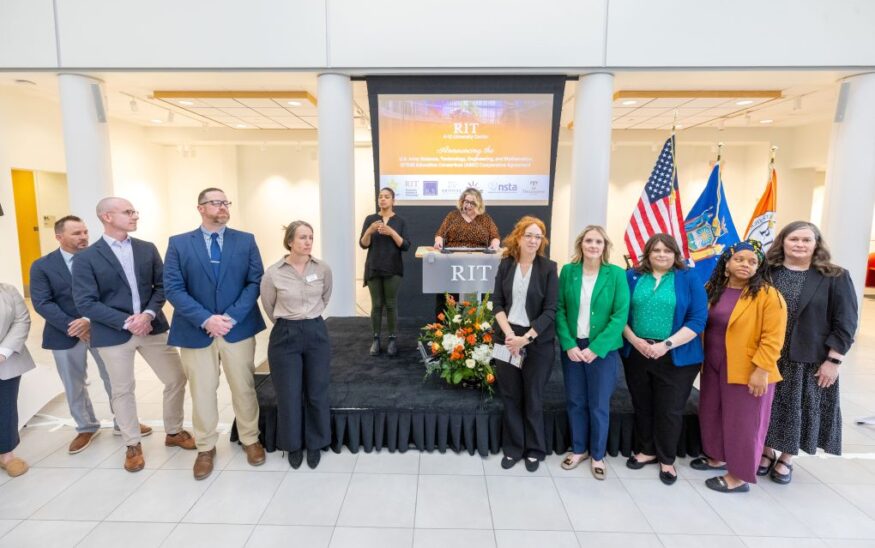
RIT is leading a consortium to build a pipeline to STEM education and careers. Donna Burnette, center, executive director of RIT’s K-12 University Center, and partners announced the consortium funded by the U.S. Department of Army STEM at a news conference on May 5. (Photo credit: Carlos Ortiz/RIT)
RIT is leading a consortium to build a pipeline to STEM education and careers. Donna Burnette, center, executive director of RIT’s K-12 University Center, and partners announced the consortium funded by the U.S. Department of Army STEM at a news conference on May 5. (Photo credit: Carlos Ortiz/RIT)
Army selects RIT to head national STEM education initiative


 Listen to this article
Rochester Institute of Technology has been selected by the United States Department of the Army to establish and lead the Army STEM Education Consortium, a national initiative aimed at strengthening the country’s science, technology, engineering and mathematics workforce pipeline.
The cooperative agreement positions RIT at the center of the Army’s long-term STEM education and workforce development strategy, with programs designed to engage students and educators from elementary school through postdoctoral study.
RIT will oversee a nationwide network of academic, nonprofit, government, and private-sector partners tasked with expanding STEM enrichment programs, internships, competitions, educator training and career pathways aligned with national security
Donna Burnette, executive director of RIT’s K-12 University Center and chair and principal investigator of the consortium, said the initiative is designed to evolve alongside workforce and technology demands.
“The future of STEM education and workforce development is rapidly evolving,” Burnette said. “To remain effective and impactful, Army STEM must be flexible, adaptive and innovative and anticipate the needs of the future workforce and the mission it supports.”
A major focus of the consortium will be creating a connected STEM ecosystem that encourages long-term engagement.
Students introduced to Army STEM opportunities early in their education will be able to continue participating as mentors, researchers, educators, and professionals throughout their academic and career journeys.
RIT President Bill Sanders said the scale of the initiative gives it national significance.
“Through this consortium, RIT will coordinate a nationwide network of partners to deliver STEM education and workforce development programs that reach students and educators from elementary school through postdoctoral study,” Sanders said. “This is not about steering students toward a single career, but about opening doors to exploration, preparation and possibility.”
Consortium partners include Blake Learning Solutions, Griffiss Institute, ICF Incorporated, National Science Teaching Association, and Tennessee Technological University. The organizations will support program delivery, educator engagement, workforce development, strategic communications and data analytics.
[email protected] / (585) 653-4021
d