Sign In
Upcoming Event
 Free Newsletter

Rochester’s CRE market remains stable despite interest rate concerns
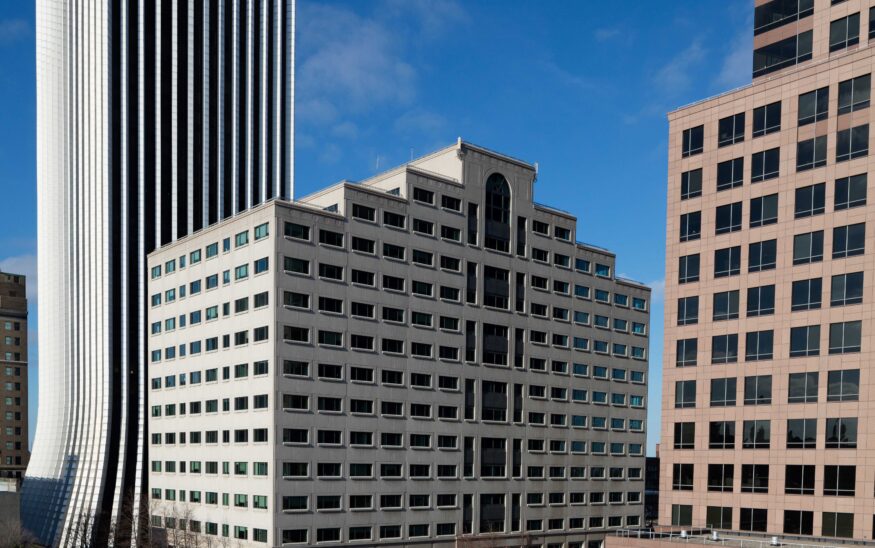
Clinton Square. (File photo)
Clinton Square. (File photo)
Rochester’s CRE market remains stable despite interest rate concerns


 Listen to this article
Summary:
- Industrial vacancy rates remain low at 4 to 5 percent
- Rochester Downtown Development Corp. reports $625 million investment
- Deal activity is solid despite higher interest rates
- Multiple downtown office-to-residential conversions underway or planned
Stability continues to be a hallmark of Rochester’s commercial real estate market, and while industry headwinds do present challenges, developers and lenders continue to find ways to navigate pathways to progress.
That was the consensus of stakeholders assembled for the Rochester Business Journal’s recent State of Real Estate Virtual Panel Discussion, sponsored by ESL Federal Credit Union and NexTier Bank.
Vacancy rates remain low in the industrial sector (just 4 to 5 percent), retail is surprisingly steady, the demand for multifamily development is prevalent, and office, though stagnated by continued lower-class vacancies, still very much has a place in today’s business environment.
“Deal activity is strong, the market is strong; there’s no real sector driving the area down,” said Michael Aiello, senior vice president of commercial lending for NexTier Bank. “It just goes back to driving efficiency and innovation. And that’s not just all on the developers, it’s on the financial institutions and the operators within that space.”
That’s because interest rates are a concern. Four or five years ago, developers and building owners locked in rates at around 3 percent. Now they’re in the 6 percent range, meaning more money is needed up front for a project.
The higher interest rates impact developers’ ability to repay, so lenders are cautious when determining financing packages.
WATCH FOR FREE: State of Real Estate Virtual Panel Discussion
“Developers must put more equity into projects to ensure they meet the loan to cost requirements,” said Jon Fogle, manager of commercial banking at ESL Federal Credit Union.

“Typically, we’ll require a debt-service coverage ratio of at least 1.2 times to ensure loan repayment. As a result of the higher interest rates, the debt service rates have also increased.”
Interest rates were expected to dip this year, with the Federal Reserve projected to cut rates twice. Now, however, with inflation fears on the rise and the war in Iran causing havoc in the markets, rates may remain stable. The Fed in late April opted not to initiate a rate cut.
Aiello said that mean developers may need to reevaluate projects that they intended to launch in 2026.
Conversions address multifamily shortage
Demand for multifamily units remains quite high and lenders are willing to finance the right deal, since vacancies in existing properties are low and apartment rents continue to rise, albeit at a more tepid rate than in recent years.
Interest rates and construction costs can present challenges, however.
“We don’t see a big issue on the loan-to-cost side from the appraisal standpoint, it’s mostly restrained on cash flow,” Aiello said. “So, banks are looking to help developers out with strategizing with longer amortizations to help that cash flow.”
Sometimes, though, converting an existing office or commercial building into residential space makes more sense than building new, especially downtown.
In the past decade, developers have unveiled conversions that created Tower280, The Metropolitan, Innovation Square and Sibley Square, plus The Terminal Building, the Gannett Building (now the Edmond) and The Rockford (old City Hall). A similar conversion of First Federal Plaza could take place, depending on who buys the property.
“If developers have an opportunity to figure out a conversion (of office space), opportunity is there, it fills fairly quickly,” said Peter Gillett, associate real estate broker at Flaum Management.
Indeed, downtown has become Rochester’s most populated neighborhood. There are 10,800 residents and another 1,500 units are in the pipeline or under construction.
Investment in downtown totaled $491 million in 2024/2025 and climbed to $625 million in 2025/2026, said Galin Brooks, president and CEO of the Rochester Downtown Development Corp.
“The energy is real and growing,” Brooks said.
Underway, or soon to begin, are conversions into mostly residential space of the Tichner & Jacobi building on St. Paul Street, the Gateway Building on East Main Street, the former Rochester Savings Bank building at West Main Street and Fitzhugh Street, the Rochester Club on East Avenue and the top seven floors of Clinton Square on East Broad Street.
“We’re seeing a growing interest in adaptive reuse,” Fogle said. “We think this is a result of the office space experiencing the highest vacancy rates by far locally, the housing shortage, the low multifamily vacancy rates, and increased construction costs.
“If the building has the right bones and structural features, developers can adapt a portion or all of the space into residential space in a cost-effective manner.”
Office still has a place
While the overall square footage footprint of office space has shrunk, the sector is still relevant, at least Class A office where flight-to-quality remains very real.
“Class A is still performing the best,” Brooks said. “We’ve seen positive net absorption, an increase in occupancy and a slight increase in rents. Most of our towers are at 80 percent or higher occupancy and a lot of them are in the 90s.
“That Class A office space continues to perform well. It’s the B-C, kind of lower-tier spaces, where there is some pain.”
Said Aiello: “As renewals come up in the office space, although someone might be going down in square footage, they’re not closing up. They’re still looking to renew; they’re still looking to have a door to walk through to meet in person.”
Which is why building owners are working with tenants when leases come up for renewal.
“Our best tenant is our current tenant,” Gillett said. “The cost to have a vacancy and remodel a space and pay (broker) commissions, you really end up going backward.
“We’re really focusing on customer service. You have to spend more money on upgrades to keep people.”
On the industrial side, one reason industrial vacancy is low: there’s a lack of new product, which means supply is still limited. And that may not change in the near future because the cost to build makes if difficult for developers to keep leasing rates low.
“The challenge is working the numbers on new-builds,” Gillett said. ” Trying to build new and work the numbers from a lease standpoint is difficult, because construction costs are so high.”
Projects rely on the power grid
Interest rates and construction costs have always impacted real estate development. But today there’s a new factor that looms even larger: Connectivity to the electric grid.
Developers and builders already have had projects stifled by an inability of utility companies to provide electricity.
“Getting the power up and running continues to be a challenge and a source of delays,” Brooks said. “It is, unfortunately, something that is holding us back.”
Impending state mandates concern all-electric buildings will only exacerbate the problem.
“That could significantly impact the cost and timing of particular projects,” Fogle said. “We’re hearing that almost every time we’re talking to a developer.”
[email protected]/(585) 653-4020
b