Sign In
Upcoming Event
 Free Newsletter

Rochester executives share playbook for AI implementation
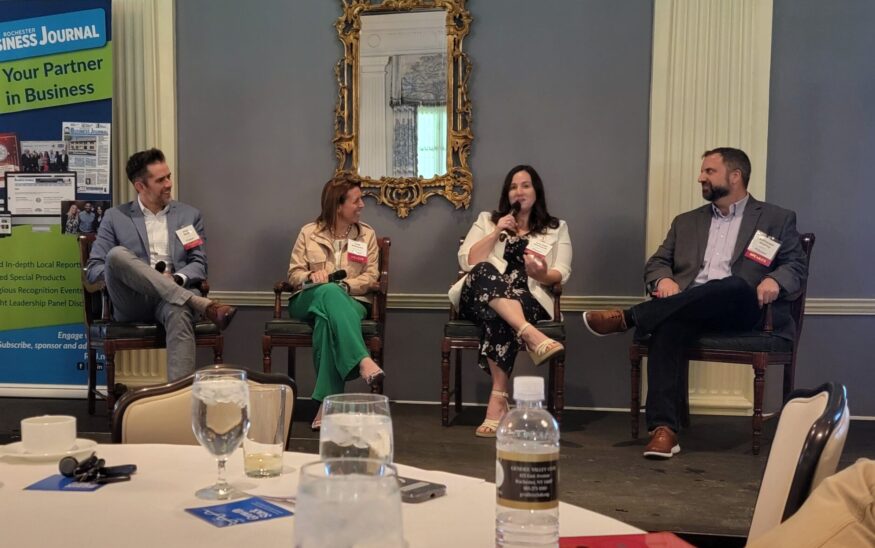
Summit panelists share what has worked, and what hasn’t, when incorporating AI into their companies. Pictured are Kyle Psaty, vice president of sales and marketing, ITX Corp.; Jane Bernard, chief financial officer, Nixon Peabody; Malorie Benjamin, chief transformation officer, Dixon Schwabl + Company, and Anthony Scinto, CPA, chair of the tax department, MMB+CO. (Photo by Andrea Deckert)
Summit panelists share what has worked, and what hasn’t, when incorporating AI into their companies. Pictured are Kyle Psaty, vice president of sales and marketing, ITX Corp.; Jane Bernard, chief financial officer, Nixon Peabody; Malorie Benjamin, chief transformation officer, Dixon Schwabl + Company, and Anthony Scinto, CPA, chair of the tax department, MMB+CO. (Photo by Andrea Deckert)
Rochester executives share playbook for AI implementation


 Listen to this article
Key takeaways:
- Local business executives cited gains in productivity, forecasting, analytics, content creation and customer insights through AI tools at a recent AI summit in Rochester.
- They noted that employee training and hands-on experimentation remain key to building comfort and accelerating adoption.
- Clear AI policies and governance frameworks are also critical to responsible adoption.
- Business leaders must balance innovation with responsible use to maximize value and minimize risk.
As organizations across industries race to identify practical applications for artificial intelligence, finance and marketing executives are increasingly focused on a fundamental question: How can AI investments deliver measurable business value?
That challenge took center stage June 18 at an AI summit hosted at the Genesee Valley Club, where business leaders shared lessons learned from deploying AI across their organizations and discussed strategies for translating emerging technology into tangible business outcomes.
Presented by the Rochester Business Journal in collaboration with Cause + Effect Strategy, Dixon Schwabl + Company, FLX AI and Strategy, the event brought together finance and marketing leaders from a range of industries to explore real-world use cases, implementation strategies and the organizational changes required to successfully integrate AI into everyday operations.
Discussions focused on practical applications ranging from forecasting and analytics to content creation and customer insights. Attendees also examined how to identify high-impact opportunities, evaluate AI investments responsibly and build organizational alignment around adoption.
The keynote address was delivered by Sid Bendre, co-founder of New York City-based Oleve, who shared insights on how AI-native companies are leveraging the technology to scale rapidly while maintaining lean teams.
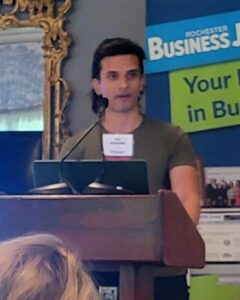
“AI-native teams are the experiment, and everyone else gets (to benefit from) the results,” Bendre told attendees.
A Forbes 30 Under 30 entrepreneur and a 2023 University of Rochester graduate, Bendre declined an offer from Palantir to launch Oleve, an AI-native consumer technology company that has grown to more than 8 million users and over $10 million in annual recurring revenue with a team of just five employees.
Bendre’s apps have reached the top five in their App Store categories, including one that climbed to No. 4 alongside ChatGPT. His ventures have generated more than 2 billion social media impressions and attracted backing from technology leaders and investors connected to companies including Slack, Cognition, Tinder and Scale AI.
Drawing on those experiences, Bendre emphasized that there is no universal blueprint for AI adoption. Instead, he encouraged organizations to empower employees to identify where AI can help them achieve business goals and improve performance.
He cautioned, however, against viewing AI as a replacement for human expertise.
While AI can drive productivity gains and create efficiencies, it cannot replicate institutional knowledge, relationships or the trust that organizations build with customers and stakeholders, he said.
Bendre also stressed the importance of responsible implementation as companies expand their use of the technology.
“AI is like a machine gun,” he said. “If you don’t know how to aim it, you can create a lot of chaos.”
Following the keynote, an executive panel discussion titled “Turning AI Strategy into Action for Marketing & Finance Teams” explored how organizations are operationalizing AI and establishing governance frameworks to support long-term success.
The discussion was moderated by John C.S. Loury, president of Cause + Effect Strategy.
“AI may be new, but the responsibility of leadership is not,” Loury said.
Panelists included Malorie Benjamin, chief transformation officer at Dixon Schwabl + Company; Jane Bernard, chief financial officer at Nixon Peabody; Kyle Psaty, vice president of sales and marketing at ITX Corp., and Anthony Scinto, CPA, chair of the tax department at MMB+CO.
The panelists shared examples of how AI is helping automate routine tasks, improve efficiency and free employees to focus on higher-value work, including customer engagement and strategic decision-making.
Scinto said AI is helping “elevate the human” at MMB+CO by accelerating employee development and supporting retention efforts through increased productivity.
Bernard described how Nixon Peabody is fostering what she called an “AI mentality” across the organization, encouraging employees to actively incorporate AI into their work and participate in company-wide AI challenges.
“We want employees to get comfortable using it and talking about how they are using it,” Bernard said.
Psaty highlighted the importance of clear guardrails, explaining that ITX Corp.’s leadership team developed a set of AI guidelines outlining acceptable and prohibited uses of the technology. The framework, he said, gave employees confidence to experiment while maintaining appropriate controls.
Benjamin encouraged leaders to embrace a mindset of adaptability as AI capabilities continue to evolve.
“Be curious,” she said.
[email protected] / (585) 653-4021
c