Sign In
Upcoming Event
 Free Newsletter

Rochester will use incentive fund to entice airlines to add nonstops to West

Frederick Douglass Greater Rochester International Airport (Photo provided by Monroe County Communications)
Frederick Douglass Greater Rochester International Airport (Photo provided by Monroe County Communications)
Rochester will use incentive fund to entice airlines to add nonstops to West


 Listen to this article
Summary:
- County of Monroe IDA provides $150,000 seed money
- Targets for nonstop routes include Dallas, Denver, Las Vegas
- Visit Rochester to administer the new incentive fund
- Expanded air service is an economic catalyst, fund proponents say
Local economic development and tourism officials believe Rochester’s business and educational ecosystem will be strengthened if they can convince airlines to establish nonstop routes to destinations west of the Mississippi River.
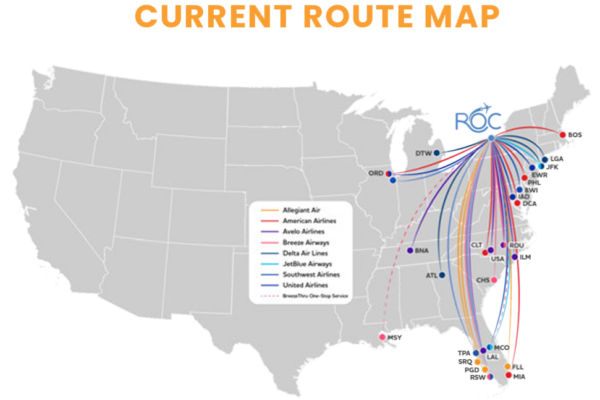
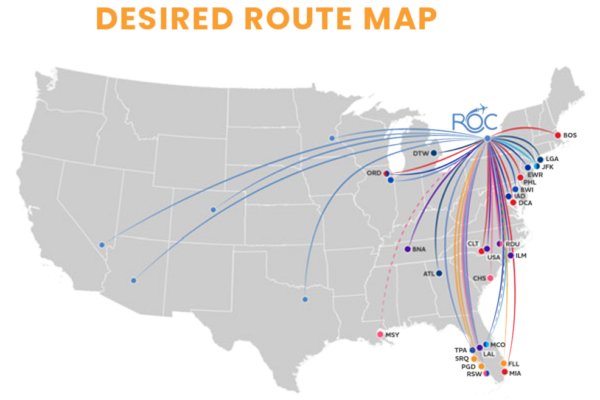
That’s why a push is underway to create a Community Airport Incentive Fund through which airlines would be compensated for providing new service from Frederick Douglass Greater Rochester International Airport, especially to major cities in the Southwest and West.
Tops on the wish list: Dallas and Denver, followed by Las Vegas, Phoenix, Minneapolis and Los Angeles.
An airline would be given cash to mitigate the risk in establishing a new route and/or marketing dollars for promotion.
The County of Monroe Industrial Development Agency voted earlier this month to provide $150,000 in seed money for the fund, which has the support of county leaders, economic development alliance OneROC, Greater Rochester Enterprise and the Greater Rochester Chamber of Commerce and will be administered by Visit Rochester.
Their reasoning for creation of the fund, which was presented to the COMIDA board at the June 16 meeting: Expanded air service is a catalyst for economic growth. Backers say businesses are more likely to consider expansion to Rochester if it is easily accessible from all parts of the country, workforce mobility is enhanced and existing firms maintain an ability to compete in a connected economy.
A study by the National Academy of Sciences published in 2025 showed that 100 additional passengers to an airport will equate to the creation of one new job over the course of a year.
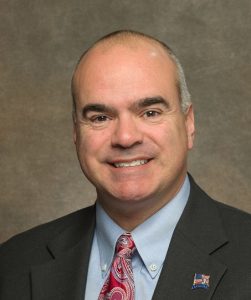
“I have regular discussions with GRE, the Chamber and OneROC, and air service comes up in conversations with companies looking to locate in Rochester,” Airport Director Andrew Moore said.
There is also the tourism component. Visit Rochester president and CEO Don Jeffries says the tourism industry creates a $1.5 billion economic impact annually in Greater Rochester. Vacationers and convention-goers that arrive by air are spending money in hotels, restaurants and stores, at cultural institutions and on ground transportation.
But convincing an airline to add a new route isn’t an easy endeavor. The airline must be assured it won’t lose money, and pretty much any city with a runway and a control tower is ready to throw a parade.
There are around 400 commercial service airports nationwide, “from large hubs down to very, very small community airports,” Moore said, “and every airport thinks they’re deserving of more air service.”

Many of those cities already have airport incentive funds. That includes a ROC competitor, Syracuse Hancock International Airport, which uses its Air Service Incentive Program to maintain existing routes and entice carriers to add new destinations.
That’s why establishing an incentive fund now is important for Rochester, Moore said.
“Community incentive programs are used to make an airport and community more attractive to airlines,” he said, adding that if you’re trying to play catch-up, you’ve already lost.
Direct service to high-demand cities can not only drive more traffic through the ROC airport but it also reduces the number of people driving to west and east to fly out of Buffalo and Syracuse.
“Attracting more destinations for the people that fly out of Rochester decreases the amount of passenger leakage (to nearby airports),” Moore added.
The major air carriers don’t frequently add routes at smaller airports, and it’s even more difficult now with high fuel costs and tighter profit margins, said Matt Hurlbutt, president and CEO of Greater Rochester Enterprise.

“We want to put our best foot forward and be more creative in the way we can help the airlines,” Hurlbutt said.
Denver and Dallas are the routes that Rochester officials want most. A nonstop to Denver provides easy connections to a multitude of other cities. On average there are 65 passengers a day leaving Rochester for Denver, and at certain times during the year the number climbs to 80, Moore said. On average there are 80 passengers a day flying from ROC to Las Vegas.
An critical component of the equation: ensuring any added nonstop creates new traffic, not just a means for the same traveler to avoid connections.
“Airlines don’t want to cannibalize other routes,” Moore said.
As airport director, Moore can speak with airlines, create marketing packages and act in an advisory role in efforts to recruit new routes. But, under Federal Aviation Administration rules, can’t be involved in any negotiations for new service. With the incentive fund, that would be done by Visit Rochester.
Passenger trends at ROC are encouraging. Passenger traffic grew by 4 percent in 2025 and was up another 4 percent year over year through May of this year.
“Business travel is coming back and people still like to take vacations and go visit friends and family,” Moore said. “But ultimately this is an economic development initiative.”
[email protected]/(585) 653-4020
c