Sign In
Upcoming Event
 Free Newsletter

Webster firm integrating tech into Rochester-area snow removal
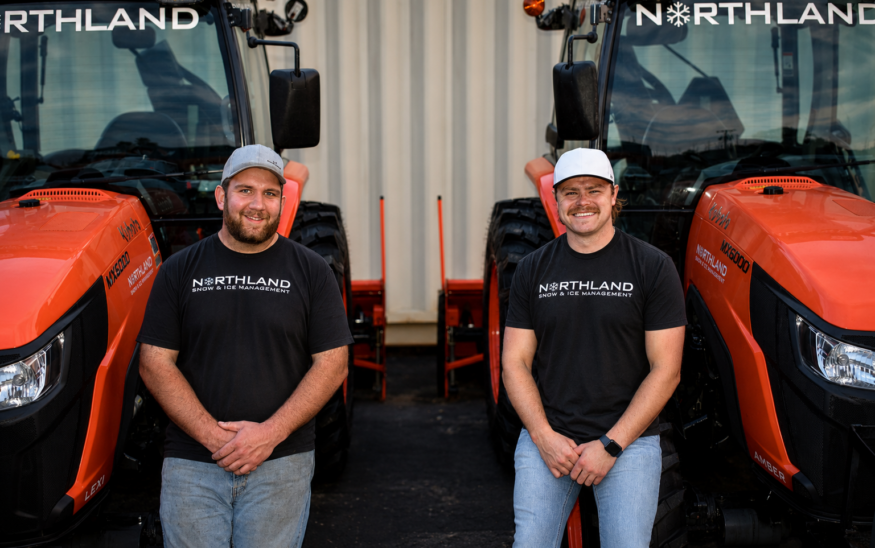
Lucas Parkison and Greg Monrad, co-owners of Northland Snow & Ice Management.
Lucas Parkison and Greg Monrad, co-owners of Northland Snow & Ice Management.
Webster firm integrating tech into Rochester-area snow removal


High-tech software will not by itself clear a foot of snow from your driveway.
It can, however, make the process of removing that snow a whole lot more efficient and customer-friendly for those operating snow removal companies.
Just ask Greg Monrad. He has turned his high-school-kid-with-a-truck part-time job into a rapidly growing business venture.
By integrating technology into everyday activities, Northland Snow & Ice Management is able to show residential customers to the minute when their driveway will be cleared while also providing equipment operators the layout and caution areas along every driveway.
The efficiencies have been a hit with customers, Monrad said, one reason Northland’s client base has grown from around 100 three and four years ago, to about 500 the past two years. And why he and partner Lucas Parkison, anticipate close to 1,000 residential customers for the upcoming season.
“Everyone wants to know when the person is going to be there,” Monrad said. “ ‘Why aren’t they here yet, why haven’t they cleared my driveway?’
“People hate wondering but they don’t really mind waiting. We have devised a way to keep the customer informed, letting them why we’re doing it this way and an exact time when we’re going to be there.”
It’s especially helpful for clients who park overnight on the driveway that is being serviced.
“When they get a text saying we’re going to be here down to the second, they’re able to run out and move their cars, watch us do our thing and then watch us take off,” the 26-year-old Monrad.

He’s able to coordinate business operations and technical integration while still working his day job, which is running Raymond W. Swallow Insurance. His great-grandfather founded the firm in 1948.
His early years at the insurance agency actually helped shape the Northland business model.
“At the time in my insurance job, I was insuring the tough stuff or the stuff that had a lot of claims, stuff nobody (other agencies) wanted,” he said. “I kind of transitioned that to ‘I want to do the driveways these contractors don’t want; these tight ones or the ones where there’s nowhere to put the snow.’ I can come in and almost save the day because everyone has always told them no.”
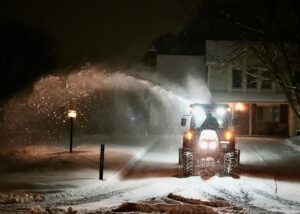
Because the company uses compact tractors with snow-blowers mounted on the back instead of plow trucks, they’re able to clear tight spaces or shoe-horned driveways that lack the space to pile snow.
“We’re just scooping it up and blowing it into the yard, we’re not back-dragging it and taking half the grass line with it,” Monrad said. “The tractors are compact, they’ve got a good a turning radius, they’re very strong, they don’t break and they hold up in the cold.”
He began plowing snow with his truck in 2018 while still in high school. He had four clients. While in college at Roberts Wesleyan, the client base grew to 30, then 60 and then to 100.
“I loved making money while people were sleeping,” he said.
Monrad soon realized clearing driveways could be more than just a part-time job. But the integration of technology really moved the company forward. They began testing a tracking notification system two years ago and went all-in last year.
“We have the ability to send a real-time link that the customer opens, where they can see a flashing bubble move down the road (indicating the location of their tractor),” he said. “They can even see what side of the road (the plow) is on.
“And once we’re done, the customer has the ability to leave feedback. Right when we’re done, they get a link. They can tell us, ‘Hey, next time can you do it a little wider?’ or ‘You missed a spot.’ Those help us more than anything.”
The technology also enhances route optimization. A tractor that originally was scheduled to do a certain street could be reassigned.
“We have eight units going around they’re not all going to finish at the same time,” Monrad said. “When one finishes, we’re able to stick it on another route automatically.”
Even more important, though, is the ability to map a customer’s driveway. What’s visible today isn’t so easy to see at 5 in the morning when the snow is being whipped around by 25 mph winds.
“When everything is covered in snow, it’s hard to see,” Monrad said. “When the operator pulls into a driveway, it geocodes everything and it pops up an aerial view and street view. It shows different hazards that we have marked.”
That means his tractors cause less damage than a lot of other companies, he said, “because of all the information we’re able to put in front of the operators.”
“When we go around and stake, we check for everything,” he said. “Does the customer have a sprinkler system? Are there any manhole covers protruding over the threshold of the driveway? Is there anything the snow should be getting sprayed at, like a light post in the front yard? Are there any low overhanging trees. Is there a mailbox across the street?”

There are eight tractors in Northland’s residential fleet. The customers are primarily in Fairport and Webster, but they are looking to expand.
There are two rate packages for the typical two-wide, three-car-deep driveway: $384, plus tax, for a 17-trip plan and $484 for the unlimited plan.
Northland also has a commercial fleet for clients in Fairport, Brighton, Webster and Victor. “We’re not doing big-box stores, we’re doing insurance agencies and banks, stuff like that,” Monrad said.
Future expansion may be done through franchising. Since there aren’t many snow removal firms using technology to guide processes, there may be opportunities to expand on what they do.
“We’re modernizing a very, very old and traditional industry that’s been the same forever,” he said. “We have this business model that, once we get it down pat, if we can provide this kind of model that has already been built and already been proven in this area, then we think there may be franchise opportunities.”
He has already helped build a model for the insurance industry, showing that policies written for snow-specific companies can be profitable for the insurance company.
“In the past, the insurance companies didn’t want to provide snow coverage to you unless you had some sort of summer exposure as well,” Monrad said, “because they wanted to generate a little more premium and the summer stuff was notoriously less risky than the winter stuff.
“But we’ve been building a program for snow only and it’s remained profitable so far.”
[email protected]/(585) 653-4020