Sign In
Upcoming Event
 Free Newsletter

Adaptive reuse revitalizes legacy buildings in Rochester

The revitalized Harper's Corner, as viewed from the southeast corner of Main Street and Clinton Avenue. (Photo provided by Home Leasing)
The revitalized Harper's Corner, as viewed from the southeast corner of Main Street and Clinton Avenue. (Photo provided by Home Leasing)
Adaptive reuse revitalizes legacy buildings in Rochester


 Listen to this article
Summary:
- Jim McKenna highlights adaptive reuse benefits at LeChase Construction
- LeChase upgrades Saunders Center for Orthopaedics infrastructure
- Ed Kurowski cites craftsmanship advantage in Pike Construction projects
- Pike uses building scans to reduce risks in restoration work
Adaptive reuse is gaining momentum across the country as communities look for creative ways to address housing, economic development and preservation goals. In Rochester, developers and construction firms say adaptive reuse is helping breathe new life into legacy buildings while strengthening neighborhoods and business districts.

“Restoring underutilized buildings can bring new life to an area – attracting more people and activity, supporting surrounding businesses and even spurring additional revitalization,” said Jim McKenna, senior vice president, LeChase Construction Services. “It can also provide an emotional boost by transforming an empty reminder of the past into a symbol of growth and optimism for a community’s future.”
McKenna said adaptive reuse projects often offer advantages that new construction cannot, particularly when it comes to existing infrastructure, location and architectural character.
“Often, repurposing an existing building provides savings in both time and budget,” he said. “Starting with a shell, and perhaps some basic utilities already installed, can pare the scope considerably depending on the situation.”
He added that many older buildings also feature “unique craftsmanship and architectural details that are attractive to prospective users or tenants,” while their locations can make them especially valuable in areas where undeveloped land is limited.
“In city areas where undeveloped space is scarce, reuse can be a desirable alternative to demolition and new construction,” McKenna said.
With construction costs continuing to increase, McKenna said more local clients are exploring adaptive reuse across a wide range of sectors.
“As the price of materials continues to rise, we see a fair number of Rochester-area clients considering adaptive reuse for many types of projects, including medical spaces, housing and even schools,” he said. “It’s a trend we expect will continue in the foreseeable future.”
At the same time, adaptive reuse projects can present significant challenges depending on the building’s condition and intended use. McKenna noted that restoration work may involve hazardous material removal, structural upgrades and unexpected conditions uncovered during construction.
“A building’s age may make renovation or restoration more expensive and time-consuming than new construction,” he said.
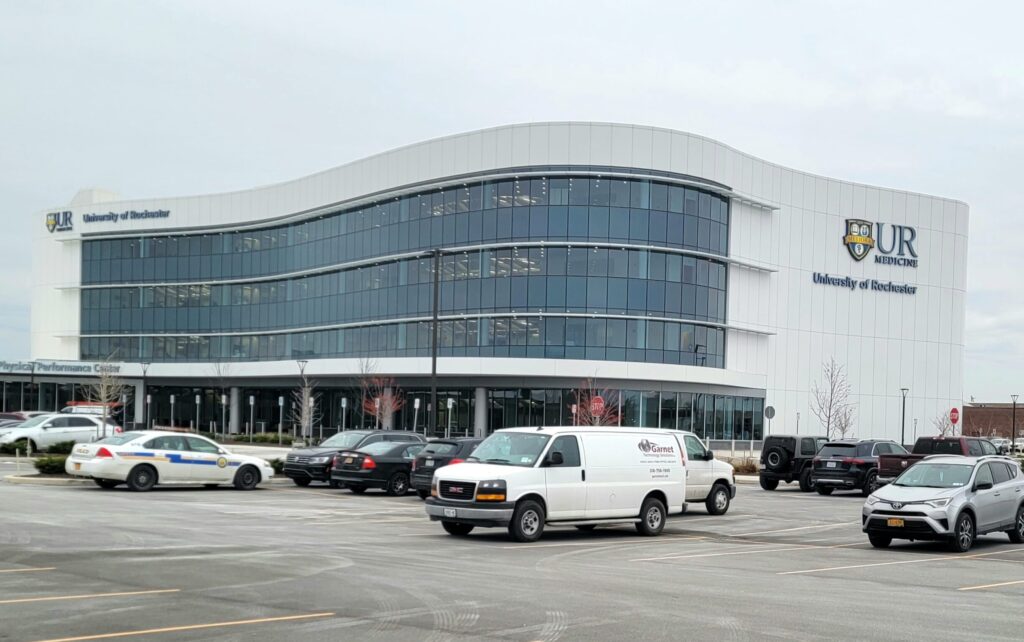
McKenna pointed to LeChase’s work on UR Medicine’s Saunders Center for Orthopaedics and Physical Performance at Marketplace Mall as an example of how dramatically a building’s infrastructure may need to change during adaptive reuse projects.
“Basic services – gas, water, electric, HVAC – that were sufficient for a retail store had to be upgraded for medical use,” McKenna said. “The shell itself also had to be reinforced with supplemental steel to accommodate the weight of equipment and other elements needed in a medical facility.”
Preserving a building’s character while modernizing it also requires careful planning and collaboration, he said.
“It’s a matter of time, budget, and focusing on the key elements that give the building its unique character,” McKenna said.
Even when original features are damaged or missing, McKenna said fabricators and specialty firms can often recreate historic details using modern materials and methods. He added that successful preservation efforts ultimately depend on “close collaboration between the owner, contractor, designer, and, at times, preservation authorities.”
For Ed Kurowski, executive vice president at Pike Construction Services, one of the greatest advantages of working with legacy buildings is the craftsmanship and infrastructure already in place.
“The new buildings that are coming out don’t have the same architectural features and the same materials that have been used in the past,” Kurowski said. “To build something new to match something that was built 100 years ago, you just don’t see it anymore. It’s not cost-effective.”
He added that many adaptive reuse projects also benefit from existing utilities and infrastructure already connected to the site.
“When you have an existing building, a historic building, or a legacy building, that existing infrastructure is already there, so that’s a huge advantage over new construction,” he said.
Adaptive reuse can also support sustainability goals by reducing waste generated through demolition and new construction.
“When we’re always looking to be sustainable and really lessening the environmental impact on our projects, there’s definitely reduced waste when it comes to an existing building versus new construction,” Kurowski said.
Still, older buildings can come with significant unknowns that affect both project timelines and budgets. He noted that hidden conditions such as structural damage, outdated mechanical systems, asbestos and lead paint can create unexpected complications during construction. To help reduce those risks, Pike increasingly uses building scans and other technology early in the process.
“We scan the building, we do the coordination early on,” Kurowski said. “That helps us understand and reduce that risk.”
Balancing preservation with modernization also requires careful planning, particularly when new electrical, plumbing and HVAC systems must be integrated into historic spaces.
“You want to minimize the disturbance of the building,” Kurowski said. “Minimize where you’re cutting holes in the building and prevent altering or getting rid of something that’s historical or has uniqueness to it.”
He pointed to Pike’s restoration work at the Rochester Broadway Theatre League’s West Herr Performing Arts Center and Auditorium Theatre and George Eastman Museum as examples of how technology can help preserve historic character while modernizing buildings for current use.
Caurie Putnam is a Rochester-area freelance writer.
n