Sign In
Upcoming Event
 Free Newsletter

Home Leasing transforms downtown Rochester ‘abomination’ into Harper’s Corner

The revitalized Harper's Corner, as viewed from the southeast corner of Main Street and Clinton Avenue. (Photo provided by Home Leasing)
The revitalized Harper's Corner, as viewed from the southeast corner of Main Street and Clinton Avenue. (Photo provided by Home Leasing)
Home Leasing transforms downtown Rochester ‘abomination’ into Harper’s Corner


 Listen to this article
Key takeaways:
- Home Leasing completed the $13 million Harper’s Corner redevelopment
- Project created 11 income-restricted workforce apartments plus four commercial spaces
- Four historic 1800s buildings were repurposed into an interconnected mixed-use site
- Development leveraged DRI funding and historic tax credits
When the mayor of the city of Rochester himself calls a site in the heart of his city “an abomination,” you know it’s bad.
But there was really no other way to describe the condition of the buildings on the northwest corner of East Main Street and North Clinton Avenue.
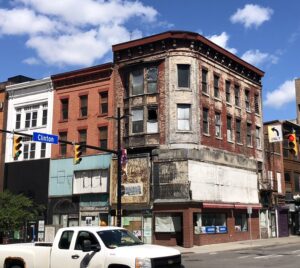
Once directly in the center of a bustling retail district, the buildings wrapping that prominent corner had become downtown’s greatest eyesore. For years, defaced brick, broken windows and boarded-up storefronts greeted the thousands of daily passersby.
And those were the good qualities of the four intertwined buildings that comprised the corner, structures that dated back to the 1800s.
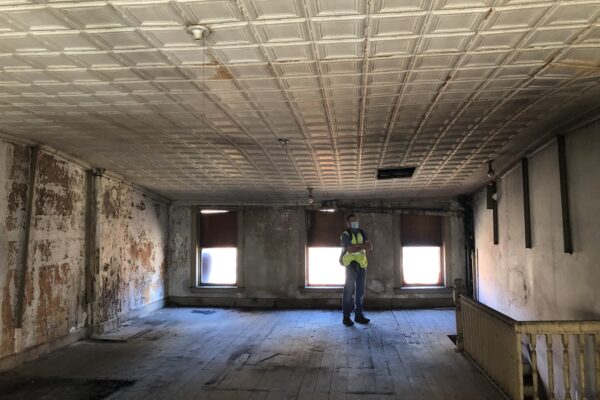
Hidden from view were the crumbling bricks inside, the structural integrity issues and the unsightliness of what essentially was an undisturbed pigeon sanctuary. The neglected properties defined urban blight.
But today, thanks to the efforts of Home Leasing and project partners, those buildings have been reborn as Harper’s Corner, a $13 million mixed-use development featuring 11 workforce apartments and four street-level commercial spaces.
Now the corner is a testament to what collaboration between public and private entities can accomplish. Instead of urban decay, there has been the beginning of a rebirth.
“In a district where perception is reality, that (previous) level of visible deterioration sent the wrong message to residents, visitors and prospective investors,” said Erik Frisch, the city’s deputy commissioner of business and neighborhood development. “It suggested stagnation at the very crossroads of our city.
“Today, that narrative has changed. Through a thoughtful partnership led by Home Leasing, and supported by state historic tax credits, these four historic structures have been carefully connected and restored into 11 high-quality apartments and street-level commercial spaces while preserving defining architectural features.”
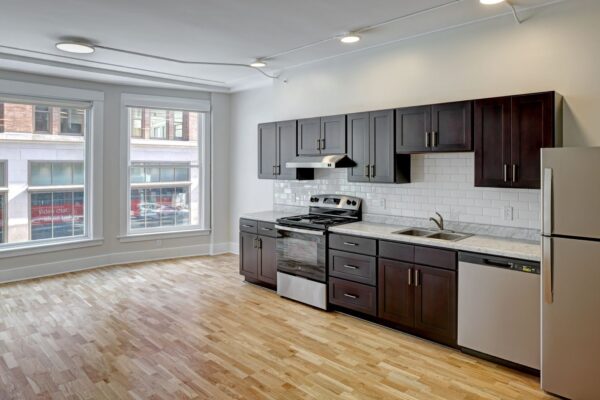
Harper’s Corner includes 10 one-bedroom units, each with a den, while the other unit is a two-bedroom apartment. Eligibility is tied to income; tenants cannot earn more than 80 percent of the Area Median Income.
As January was ending, nine of the 11 units were occupied and the vetting process was being completed on the other applicants. There are 75 individuals on the waiting list, underscoring the critical need for quality, affordable housing.
“The waiting list says it all,” said Theodora Finn, president of the Greater Rochester Housing Partnership. “Every one of these units, along with the revitalization of this corner, is remarkable.”
Throughout the history of the four buildings, there was never residential space, said Lindsey Allen, development manager at Home Leasing. The four floors had always featured commercial uses. But Home Leasing does housing, and creating residential units within the buildings enabled the development team to tap into significant state and federal funding.
City officials designated $4 million of a 2022 Downtown Revitalization Initiative award from the state to the project. The city also allotted $2.4 million through Empire State Development and the Regional Revitalization Partnership. Homes and Community Renewal provided another $2 million from its Community Investment Fund, with another $3.9 million coming from Federal and State Historic Tax Credits.
“The collaboration was the only way a project like this would get done,” Allen said.
Said Frisch: “When we reinvest in highly visible sites like this, we shift both perception and momentum.”
Repurposing of the dilapidated structures was no easy task, however.
“One of the biggest challenges was how to make four buildings function as one community,” Allen said.
They were able to do so, thanks to the project team that included IN/EX Architecture, Jensen/BVR (structural engineering services) Marathon Engineering (civil engineering services) and Home Leasing’s affiliated in-house contractor, Home Leasing Construction LLC.
When it came to the ground floor commercial space, the decision was made to create four separate areas, although the three along Main Street remain connected and could be used by one tenant if necessary. Of those three, the largest has 1,400 square feet of space; the other two are 900 square feet. The fourth space, at 5-7 North Clinton, is 850 square feet.
“That offers flexibility in leasing these desirable ground floor spaces,” Allen said. “We didn’t want to limit the possibilities.” So far, letters of intent have been issued on three.
Because the project qualified for historic tax credits, the developer was required to adhere to renovation guidelines. The exterior and interior brick needed to resemble what once was. So, too, did the windows and ceilings.
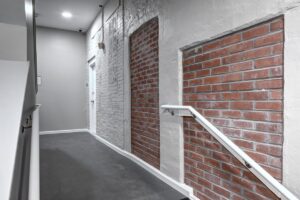
The age of the buildings created quite a range of restoration possibilities. The look in the 1880s was different than it was in the 1930s, and different from the 1970s, but there was no preservation mandate on what era must be replicated.
“We could pick any era,” Allen said, “but once we did, we had to find documentation and then stick with it throughout.”
Home Leasing’s development team opted to create a look that resembled the 1940s; when possible, design elements from that era were preserved. In the ground floor space along North Clinton, the decorative tin ceiling was restored. But in the space at 220-222 East Main, the original tin ceiling couldn’t be salvaged, so the new material was made to resemble the past.
In renovating the ground floor space at 224-226 East Main, crews found about five layers of various flooring. The bottom layer was historic terrazzo, which was restored and provides the 1920s/1940s vibe.
Because photos from the 1930s and 1940s showed glass block windows along the east wall, similar glass block windows were required to meet preservation guidelines.
Some elements of the buildings could not be removed. For instance, one apartment has a staircase to nowhere. “We were required to keep it,” Allen said.
If nothing else, it’s a conversation piece, and perhaps a place for plants. Ensuring elements of 1940s were preserved didn’t mean the entire project needed to be stuck in the past. For instance, the buildings now are all-electric.
Construction finished in early November. Residents began moving in toward the end of December.
The project was completed on schedule and on budget, and using the affiliated Home Leasing Construction as the general contractor was beneficial, Allen said.
“If they needed to pause because they found an issue in one building, they could relocate to a different building while we solved the problem,” she said.
The name Harper’s Corner was chosen to honor Martha Matilda Harper, the first woman member of the Rochester Chamber of Commerce. She is credited with inventing the modern beauty salon, establishing her first salon a few blocks to the west in the Powers Building in 1888.
She later pioneered the first franchise business model and over the years her name graced more than 100 salons across the country.
“This exciting project marks another step towards strengthening our urban core and revitalizing downtown Rochester,” Congressman Joe Morelle said when the state announce project launch in the summer of 2024. “It is particularly fitting that the name Harper’s Corner will reflect our long history of entrepreneurship while bringing us into a new era of economic growth.”
It’s growth that is apparent and, the city hopes, contagious.
“The transformation of Harper’s Corner represents more than the rehabilitation of four historic buildings,” Frisch said. “It marks the restoration of confidence in one of the most visible intersections in downtown Rochester.
“This kind of transformation does more than improve a single property. Revitalizing such a prominent corner strengthens the entire downtown ecosystem. It restores architectural character, increases residential density, supports nearby small businesses and signals that long-challenged spaces can once again be productive and beautiful.”
[email protected]/(585) 653-4020
a