Sign In
Upcoming Event
 Free Newsletter

Stadium design expert LaBella Associates embraces modular concepts

Rendering of Tidewater Landing, a 10,000-seat soccer stadium that is the centerpiece of a multiuse development in Pawtucket, Rhode Island. (Image provided by LaBella Associates)
Rendering of Tidewater Landing, a 10,000-seat soccer stadium that is the centerpiece of a multiuse development in Pawtucket, Rhode Island. (Image provided by LaBella Associates)
Stadium design expert LaBella Associates embraces modular concepts


 Listen to this article
SUMMARY: LaBella Associates has worked on over 85 stadium projects in 35 states. The firm is the preferred design partner for USL stadium developments. Modular design offers scalable, cost-effective solutions for growing teams. New stadiums in Buffalo, Bridgeport, and Homestead feature hybrid or modular construction.
The LaBella Associates footprint within the realm of stadium design stretches up and down the east coast and westward.
Over the past 20 years, the Rochester-based multidisciplinary firm has worked on more than 85 sports and entertainment projects in 35 states, with signature facilities in Charlotte, North Carolina (the Spectrum Center), Tulsa, Oklahoma (BOK Center) and High Point, North Carolina (Truist Point Stadium).
The firm also designed the new Tiger Stadium at Rochester Institute of Technology using conventional architecture methods and served as civil engineer for the new Highmark Stadium, which will be home of the Buffalo Bills.
By creating contextual, aesthetically stunning, highly functional structures, the LaBella design architects and engineers have helped set the standard for today’s sporting playgrounds.
But they’re not afraid of change. Modular is not a four-letter word in disguise when it comes to stadium architecture. In fact, LaBella has embraced the concept of modular design when it makes sense, which can mean more cost-effective and efficient stadium creation.

“We’re not conventional stadium designers, we’re not modular stadium designers; we don’t pigeonhole ourselves as anything,” said Cristian Petschen, public venues practice leader at LaBella. “We are architects and we will sit with you and find out what your needs are for a very specific project and then decide what’s the best design, construction systems, etc. for your project.
“We want to make sure we do the right thing for the right place at the right time. For some projects, modular is actually a better option.”
Like in Buffalo, where soccer backers will be building a 7,600-seat, soccer-specific stadium for the 2026 USL season. It will be built in Buffalo’s Valley neighborhood at Elk and Lee streets, and will feature 12 hospitality suites, two private party areas and club-level seating.
USL is growing rapidly and LaBella is the organization’s preferred supplier of architectural and engineering services.
“Soccer in the United States can still be considered an emerging market, Petschen said. “It’s been here for a while, it’s solid, but if we look at Europe, there’s a team in every town.
“Leagues like the USL are, as a strategy, looking to make it affordable for people to get a team. USL has this model where every single town in America should have a team.”
As a preferred partner, LaBella would very likely be designing those stadiums, often with similar elements. By using modular design, LaBella can fashion stadiums that meet the needs of second- or third-division USL teams today but can be enlarged to meet future demands.
“These are new teams, and as with any new company or brand, at the beginning you’re going to have a smaller fan base,” Petschen said. “How can we make a stadium that is 5,000 (seats) today, 7,500 tomorrow, 10,000 next year and then go up to 15,000 (which is the minimum requirement for a USL Division I team)? Modular allows you to have a very easy way to have a phasing.
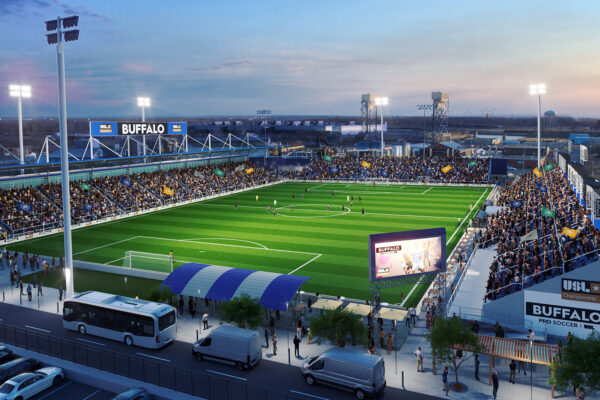
“I can design a project like the 7,500-seat Buffalo stadium but come tomorrow, as the fan base grows, we can make it a 15,000-seat stadium. It’s easy to plug in suites, it’s easy to plug in premium facilities and the tech.”
So just what does modular design entail? It’s basically allowing for easy production of repetitive elements that every stadium needs. That would include the grandstands, restrooms, concession areas, suites, the press box and perhaps canopies that cover certain areas of the stadium.
“These things are repetitive elements that are going to have certain sizes and requirements that can be made of fabricative elements that are repeatable, so those are the “modules,” Petschen said.
The concept of modular design in sports architecture isn’t new. It has been used for years by the PGA Tour, PGA of America and Formula One to create one-and-done event venues.
“But it’s new in terms of the permanence of the finished product,” Petschen said. “After COVID, construction costs skyrocketed, materials became scarce and there was volatility in the market. That post-COVID world brought upon a interest in finding solutions where you could mitigate how quickly you can build something, who quickly it can be installed, how you can phase a project where you start small and get bigger.”
He said that about two years ago, architects and designers began to look at modular as a viable alternative for certain projects.
“We’re still doing tons of conventional stadiums,” he said, “but for certain circumstances it seemed that that would be the right thing to do.”
Modular appeals because of speed to market, cost certainty and design flexibility and phase-ability.
“For conventional construction, site work essentially must be completed before the new building goes up,” Petschen said. “You really can’t build anything until you’re done with that. The site work can take three months, four months, eight months. Then you start building on top of it all.
“With modular, while you’re doing the site work, the stadium is being manufactured. 97 to 98 percent of all the work is being done in parallel with the site work. When the site work is done, you come in and install these almost Lego pieces that a premanufactured and come together rather quickly.”
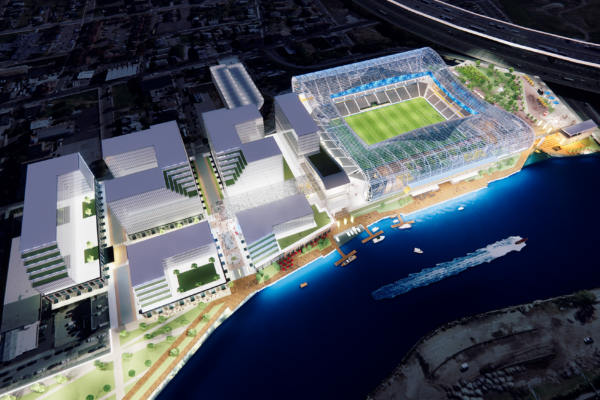
In Bridgeport, Connecticut, LaBella is designing a stadium that will open with 10,000 seats, with expansion to 20,000 possible as the team moves up the USL ladder. The design of what is viewed as a new community hub will be a mix of conventional and modular concepts.
In Homestead, Florida, the firm is designing a new stadium for Miami FC, the city’s USL team. But the facility will host a rodeo once a year, so Petschen and the LaBella staff needed to create a venue that could be easily modified.
The stadiums become more than just a place for games to be played, however. Many developers view them as a centerpiece of mixed-used developments that also feature residential, hospitality and retail components.
“About 90 percent of the projects we are doing now include these sports and entertainment districts,” Petschen said. “Post-COVID, people want to have shared, human experiences.”
There’s also one more bonus reason for choosing modular stadium design: You can list it on eBay or a real estate site for use somewhere else.
“It can be taken apart and relocated,” Petschen said. “You can sell the stadium; you can actually buy a used modular stadium. It’s an easier re-sell because it’s not location based. It doesn’t need to be on the same spot.”
[email protected]/(585) 653-4020
b