Sign In
Upcoming Event
 Free Newsletter

Steps still need to be taken to make 5G truly accessible
Steps still need to be taken to make 5G truly accessible


The implementation of 5G networks presents opportunities, challenges and risks for businesses, area experts say.
5G is the next generation of wireless networks, building upon existing 4G infrastructure.
It is expected to improve the bandwidth, capacity and reliability of wireless broadband services and meet increasing data and communication requirements, including internet of things, or IoT, devices.
When implemented, the 5G network could be used in industries across the board, from health care and education to manufacturing and retail.
Like any new technology, there are risks and rewards to implementing it.
Among the challenges are deployment and coverage, the cost to build and buy, regulations and standards, and security and privacy issues. Advantages include productivity, remote working, faster speeds and greater reliability.
Jeffrey Reinholtz, director of client experience at Innovative Solutions, says having the expanded bandwidth that 5G is expected to deliver could be more in-demand than ever before.
“Never has it been more critical to the success of so many components,” Reinholtz says, noting that in the new normal of working and learning from home, families need the increased technical capabilities to meet the needs of both parents and children when it comes to work and school.
People have become accustomed to a tech lifestyle, he adds.
“5G supports what we’re demanding,” Reinholtz says, adding the technology has been integrated into everyday life. “In today’s world, it’s as critical as a road.”
One hurdle for not only businesses, but individual users, as well, is having access to the technology, Reinholtz says.
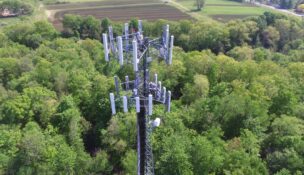
That is because the infrastructure, typically found in cell towers within communities, is not yet widespread at this time.
The infrastructure to support the new technology may look different than the cell towers we have now, too. Google LLC, for example, has recently placed transmitters on some of its existing towers and rooftops to accommodate 5G needs.
That may be a more popular option, Reinholtz says, since some people have concerns about the massive towers being erected in their communities.
“We are using resources more intelligently rather than doing things the way we always have,” he says.
In addition to finding the right way to make 5G accessible, there also needs to be controls in place from a security standpoint to make sure a company’s data is not compromised.
“It’s not just about getting people 5G for the sake of 5G,” Reinholtz says. “It’s also about setting parameters.”

John Roman is president and chief operating officer of FoxPointe Solutions, an arm of The Bonadio Group that provides cybersecurity and risk management services.
He says 5G, with its super-fast speeds over cellular networks, will likely be especially advantageous for businesses that do a lot of work in the field outside of the office.
That could apply to the oil industry where oil fields may need to be monitored or in agriculture where global positioning systems are used for tasks such as watering and irrigation of crops. In addition, Roman sees opportunities in the transportation sector, including self-driving cars.
“They may need that high bandwidth that 5G will offer,” he says.
Professional sports teams may also be among the first users of the high-speed bandwidth, he says, adding that the technology could be used in large arenas and stadiums to connect with fans.
Another potential benefit for businesses from 5G is utilizing wide area networking, which would allow a company to connect two or more of its offices wirelessly.
Depending on the costs, and what computer manufacturers build into their own products, 5G could replace WiFi networks entirely, Roman says, although he notes there has been talk of new WiFi standards that would increase speeds.
Like other networks, 5G will have security challenges that will have to be addressed, Roman says.
“With any networking technology there will be vulnerabilities that hackers and non-hackers will quickly identify,” he says. “While the hackers will exploit those vulnerabilities, the non-hackers will work to close them.”
Among the biggest challenges for small businesses when it comes to 5G is the cost, Roman says, adding the more users there are, the lower the price. That was the case with 4G and will likely happen with 5G, although he predicts the early adapters will be larger companies.
While progress has been made on 5G capabilities, work is still being done to increase its speed, and the infrastructure is not yet fully in place to support the increased bandwidth.
“Despite all the hype, it’s still not a mature technology,” Roman says, but believes the kinks will be worked out and the technology will move forward.
Mobile devices will play a big role in the 5G roll-out, Roman notes, adding that the devices need to be 5G compatible for people to use them.
Companies such as Apple Inc. and Samsung have already said their next generation of mobile devices will be compatible, he says, adding that the move will not only improve current capabilities, such as video streaming, but could lead to additional applications that may not even exist yet.
“There are a ton of opportunities,” Roman says. “The questions are how quickly will companies, users, and state and federal governments adopt it and how quickly will the infrastructure be in place to support those needs.”

Trevor Smith, executive vice president of Brite Computers, agrees that 5G will give businesses access to impressive speeds with low network latency and will likely be used in various industries, but there are still steps that need to be taken before the technology is widespread.
The Rochester area does have locations where 5G is available, but there is still an extensive amount of infrastructure that needs to be erected locally, and around the country.
So even if a business wants to use 5G capabilities, it may have to wait.
“If there’s no available service, it can’t be used,” he says.
While it will take time to get the infrastructure in place for 5G, the COVID-19 pandemic has changed the way people work, he says, noting they are using more technology.
An example is using apps such as Zoom for video conferencing, which allows real-time interaction. With 5G, that remote collaboration becomes even more realistic, Smith says.
He adds that planning is essential for businesses when it comes to implementing new technologies, and 5G is no exception.
“An organization needs to plan for any technology transfer and how it impacts their business when it comes to their people, processes and security,” Smith says.
Andrea Deckert is a Rochester-area freelance writer.
s