Sign In
Upcoming Event
 Free Newsletter

What running a school teaches you about leading any organization | Purposeful Learning
What running a school teaches you about leading any organization | Purposeful Learning


 When I tell people I lead a school, I sometimes get a knowing smile.
“Must be nice,” they’ll say. “Done by three o’clock, summers off.”
I usually laugh. Then I think about the board meeting from the night before, the fundraising breakfast the following morning, the hiring interview over lunch, the facilities issue that interrupted the afternoon, the enrollment conversation with a prospective family and the budget meeting waiting for my attention the next day.
The reality is that schools are among the few organizations that ask leaders to be CEOs, fundraisers, marketers, talent managers, financial stewards, crisis communicators, instructional experts and community builders—all at the same time. Every day requires balancing the needs of students, families, faculty, trustees, alumni and donors while keeping an eye on both immediate challenges and the long-term health of the institution.
In many ways, schools are leadership laboratories. They don’t just teach leadership—they demand it.
Leading a school like Harley requires a foundational understanding of curriculum and teaching across the entire N-12 spectrum, but also a strong business sense, an ability to build relationships, an eye toward enrollment and marketing and the leadership skills necessary to unite a community around a shared mission. Despite the particulars, running a school has convinced me that the fundamentals of leadership are remarkably universal.
Here are five lessons I’ve learned leading schools that apply to organizations of every kind.
Lesson 1: Hiring is strategy
Mission statements and strategic plans are important guideposts, but they are only as good as the people charged with bringing them to life. Every hire changes an organization’s culture — either intentionally or accidentally.
Hiring an outstanding teacher — someone who challenges students, builds meaningful relationships, communicates well with families and collaborates with colleagues — is one of the most important responsibilities a school leader has. The same principle applies in every industry. Great employees raise the game of everyone around them. They don’t eliminate the need for leadership, but they multiply its impact.
Jim Collins famously wrote about getting the right people on the bus before deciding where to drive it. I’ve found that to be just as true in education as it is in manufacturing, healthcare or business. Hiring isn’t simply an HR function. It is one of the most important strategic decisions an organization makes.
Lesson 2: Culture is what people experience, not what leaders proclaim
Culture isn’t what leaders say it is. It’s what employees experience every day.
Strong leaders intentionally shape culture through what they prioritize, model, celebrate and reinforce. But good intentions aren’t enough. Leaders also have to understand the culture that actually exists — not the one they hope exists.
That requires listening. Surveys, employee conversations, trusted advisors and honest feedback all help leaders understand where an organization is thriving and where it needs attention. Employees notice who gets thanked, who gets promoted, what behaviors are rewarded and what problems are ignored. They often have the clearest view of an organization’s culture.
Culture isn’t built during annual retreats or written into strategic plans. It’s built through thousands of everyday decisions.
Lesson 3: Accountability and care are not opposites
Many leaders mistakenly treat accountability and empathy as competing priorities. In reality, the best organizations require both.
People deserve high expectations and genuine support. Lowering standards isn’t kindness, and demanding excellence without caring for people isn’t leadership. Too often, leaders assume they must choose between being compassionate and being accountable. In reality, the healthiest organizations reject that false choice. People want to know that their leaders believe in them enough to challenge them and care about them enough to help them succeed. Accountability communicates that the work matters. Support communicates that the people doing it matter.
Leaders who focus only on accountability often lose the trust that makes people willing to do their best work. Leaders who focus only on caring can unintentionally create environments where expectations become unclear and performance suffers.
The strongest leaders find the balance. They can sincerely tell an employee, “I value you, and I expect great work from you.” Neither message is complete without the other.
Lesson 4: Change moves at the speed of trust
Organizations don’t resist change nearly as much as they resist change from people they don’t trust.
Schools, like successful businesses, are filled with intelligent, passionate and thoughtful people who care deeply about the organization’s mission. When leaders have invested time building credibility and trust, change becomes possible. Without that foundation, even the best ideas struggle to gain traction.
Smart leaders understand that trust isn’t built during moments of major change; it’s built long before them. They make and keep small promises. They communicate consistently. They admit mistakes. They follow through. By the time significant change arrives, people have already learned that their leader’s words can be trusted.
Leaders often feel pressure to move quickly toward the next exciting initiative. But meaningful change rarely succeeds simply because it’s a good idea. It succeeds because people believe in both the idea and the person leading it.
Trust takes time to build, but it accelerates every meaningful change that follows.
Lesson 5: Every leader is a teacher
Perhaps the greatest lesson school leadership offers is this: every leader is a teacher.
Whether you’re leading a business, a hospital, a nonprofit or a school, your primary job isn’t making decisions. It’s shaping how people think.
Great leaders constantly teach. They model what excellence looks like. They explain how decisions are made. They reinforce what matters most. They help people see possibilities they hadn’t considered before.
When people are learning, organizations are improving.
The best leaders also remain learners themselves. They seek feedback, welcome different perspectives and recognize that leadership is never a finished product. Leaders who continue to grow create organizations that continue to grow alongside them.
Leadership isn’t about having all the answers. It’s about creating an environment where people can do their best work, grow into their potential and pursue a shared purpose.
Whether we’re leading a school, a business, a nonprofit or a hospital, the work is ultimately the same. We hire people, build culture, earn trust, navigate change and help others grow. Titles and industries may differ, but leadership remains profoundly human.
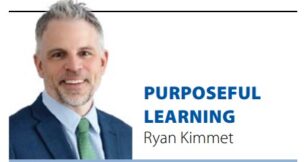
Dr. Ryan Kimmet is the Head of School at The Harley School and a veteran leader in independent education. His column explores the intersection of K–12 innovation, workforce development and the regional economic impact of modern schooling.
n