Sign In
Upcoming Event
 Free Newsletter

From fun to fulfillment: What businesses can learn from joyful learning
From fun to fulfillment: What businesses can learn from joyful learning


 Listen to this article
 Young professionals learn quickly the difference between work that is “fun” and work that is “satisfying.” Ideally, we all find opportunities to do meaningful work, whatever our field might be. Meaningful and satisfying work may include moments that are fun, but it also inevitably includes moments that are challenging and difficult. When we find work that still brings joy even in difficult moments, we often discover the foundation for a meaningful career. Joy is not the absence of difficulty; it is the presence of meaning within difficulty.
In the early 2000s, the hallmark of a high-growth workplace was the presence of “exclusive” perks — exclusive amenities like in-house climbing walls, gourmet snack bars, and high-end game rooms. While these signaled a modern startup culture, they often failed to address the foundational employee experience. As the novelty of these incentives faded, the underlying issues of burnout and turnover remained. Today’s workforce has moved past this era; they are seeking autonomy and growth under the guidance of principled leadership. True engagement isn’t a product of amusement, but of a culture rooted in trust, purpose, and meaningful collaboration.
Human beings thrive when they experience growth, purpose, belonging and agency. The same lesson applies in schools. Students may enjoy occasional moments of entertainment in the classroom, but lasting engagement rarely comes from novelty alone. Real joy in learning emerges when students feel challenged, supported, connected to one another and empowered to grow. Anyone who has watched a student become deeply invested in their work, whether it is a theater production, a science project, or a piece of creative writing, understands this distinction intuitively. The work itself may be difficult, but meaningful challenge often creates its own fulfillment.
At The Harley School, we operate on the principle that “joy in learning” is the intersection of curiosity and meaningful challenge. We see this daily: when students are immersed in relevant, discovery-based work — like a recent multi-disciplinary “focus week” on rainforest ecosystems — their investment in the outcome skyrockets.
This isn’t just a pedagogical theory; it is increasingly the blueprint for high-performing organizational cultures. When Satya Nadella took the helm at Microsoft, he famously pivoted the tech giant from a “know-it-all” culture to a “learn-it-all” one. This shift recognized that in a volatile economy, curiosity is a competitive advantage.
Organizations built on compliance and risk avoidance rarely sustain innovation. In contrast, when employees feel trusted and intellectually engaged — much like students in an immersive classroom — they become more flexible and adaptive. To thrive in a rapidly evolving market, businesses must depend on people who view continuous learning not as a requirement, but as a core component of their professional identity.
This shift may become even more important in the years ahead. As artificial intelligence increasingly automates routine tasks and reshapes many industries, uniquely human capacities such as creativity, empathy, adaptability, and collaborative problem-solving will only become more valuable. The future workforce will not simply need technical knowledge; it will require individuals who are comfortable learning continuously in environments defined by constant change.
For schools, this presents an important challenge. Education cannot simply be about delivering information or preparing students to follow established systems. Information has never been more accessible. Instead, schools must help students develop the habits of mind and emotional resilience necessary to navigate uncertainty, collaborate with others, and continue growing throughout their lives. Experiences that bridge curiosity with collaborative problem-solving instill a mindset that outlasts any individual classroom lesson. This commitment to engaged, hands-on learning ensures students develop the high-level interpersonal skills and adaptability that remain essential in an increasingly automated workforce.
In this way, “joy in learning” is not a soft or idealistic concept. It is a practical one. The students best prepared for the future may not be the ones who simply memorize the most information, but the ones who develop a lasting curiosity about the world and confidence in their ability to keep learning within it. In both schools and businesses, enduring success rarely comes from making every moment fun. More often, it comes from helping people find meaning, purpose, and even joy in the process of becoming better at something difficult.
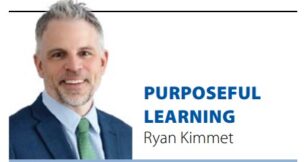
Dr. Ryan Kimmet is the Head of School at The Harley School and a veteran leader in independent education. His column explores the intersection of K–12 innovation, workforce development and the regional economic impact of modern schooling.
l