Sign In
Upcoming Event
 Free Newsletter

Flexibility as strategy: Rethinking how nonprofits build leadership capacity | Leading with Purpose
Flexibility as strategy: Rethinking how nonprofits build leadership capacity | Leading with Purpose


 Listen to this article
 Nonprofits are not struggling because people are not working hard enough. They are struggling because the way we structure leadership no longer matches the reality of the work.
Flexibility is not a compromise. It’s a strategy that must be prioritized!
In today’s environment, leadership cannot be rigid or one-size-fits-all. It needs to adapt to the needs of the organization, the pace of change, and the complexity of the work. That requires a shift in mindset from filling roles to building capacity.
My business partner, Pamela Ayers, captures this idea well: “Sometimes it’s not just about how we lead, but how we’re structured to lead.” That idea points to a broader shift already taking shape across the sector. One of the most practical ways organizations are applying it is through fractional leadership.
Fractional leadership provides access to experienced, senior-level expertise on a part-time basis, aligned to specific organizational needs. Instead of hiring one full-time executive to cover multiple functions, organizations can bring in targeted leadership where it matters most.
This is not a temporary fix or a stopgap. It is a deliberate approach to aligning expertise with outcomes. One of our team members, Tricia Williams, emphasizes this when educating others on the concept by always going back to the idea that “Fractional is not less. It’s focused.”
That focus is what many organizations are missing.
Across the sector, demand is increasing. Funding is unpredictable. Expectations continue to rise. Yet many organizations are still operating with leadership models built for a different time. When pressure builds, organizations often default to the same approach. Responsibilities get layered onto existing roles. Job descriptions expand. One person is expected to cover multiple functions.
The nonprofit sector has long romanticized the ‘Swiss Army Knife’ leader. This is the executive director who can pivot from a high-stakes donor gala to a complex audit, then fix the office copier before lunch. On the surface, this versatility looks like efficiency. In reality, it is a primary driver of organizational stagnation.
A Swiss Army knife is a fantastic tool for survival in the woods, but you wouldn’t use its two-inch blade to perform surgery or its tiny saw to frame a house. By forcing leaders to be ‘generalists of everything,’ we ensure they are ‘masters of nothing.’ We trade strategic depth for tactical breadth. When an executive director spends 10 hours a week struggling through messy spreadsheets or troubleshooting HR compliance, tasks often outside their core genius, the organization pays a hidden tax. That tax is the lost opportunity of the 10 hours they should have spent on high-level advocacy or long-term visioning.
When results fall short, the assumption is often that the individual wasn’t the right fit. In reality, it was the structure that wasn’t appropriate. This is not a staffing issue. It is a design issue.
Executive directors manage finance, fundraising, operations, human resources, and external partnerships simultaneously. Development roles are expected to handle major gifts, grants, and CRM systems. Boards step into operational decisions because there is no clear ownership internally.
Then we ask why progress stalls, why burnout is high, and why turnover continues.
Leadership capacity doesn’t match organizational demand. Fractional leadership directly addresses the gap. In practice, it allows nonprofits to strengthen key functions without overextending internal teams.
A fractional finance leader can bring consistency and clarity to reporting, forecasting, and decision-making. A fractional development leader can focus on strategy, major gifts, and donor engagement rather than being pulled in multiple directions. Operational support can be introduced to stabilize internal systems and improve execution.
The result is not more activity. It is better performance. Financial visibility improves. Fundraising becomes more strategic. Executive leaders regain time to focus on partnerships, growth, and long-term direction.
The organization may not grow in size, but it grows in capacity. Capacity is not defined by a headcount. It is defined by how effectively leadership functions operate.
Boards play a critical role in this shift. Too often, performance is evaluated based on outcomes without fully assessing whether the organization is structured to achieve those outcomes. When goals are missed, the focus turns to individual performance rather than structural limitations.
A more important question is this: Have we designed this organization to succeed?
If the answer is no, adding pressure to existing roles will not fix the problem. Too many organizations are still operating in a constant state of stretch. That approach is not sustainable. It leads to burnout, inconsistent performance, and missed opportunities to expand impact.
The greatest barrier to this shift often exists within the boardroom, where capacity is traditionally measured by headcount, and overhead is viewed with skepticism or, worse, as waste. Boards are conditioned to ask: “Can we afford a new hire?” instead of asking: “Are we investing in the right results?”
To move past this barrier, we must redefine the Return on Investment of leadership. Hiring a full-time, mid-level generalist might feel safer to a budget-conscious Board, but that individual often requires significant management and comes with a steep learning curve. Conversely, investing in a fractional expert, someone who has already mastered the specific mountain the organization is currently climbing, yields an immediate expertise dividend.
This is a fiduciary shift. A Board’s responsibility isn’t just to keep costs low; it is to ensure the organization’s structure is robust enough to carry out its mission. When we present fractional leadership not as an extra expense but as a precision tool for risk management, we change the narrative from cost-cutting to mission-building.
Nonprofits are central to solving complex community challenges. That work requires more than commitment. It requires meticulousness in how leadership is structured. Flexibility allows organizations to apply expertise where it matters most, respond to change more effectively, and build systems that support long-term success.
We cannot continue to expect high performance from leadership models that are underbuilt. If we want stronger outcomes, we need to design them. And that starts with rethinking how leadership works.
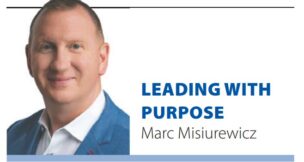
Marc Misiurewicz is founder and CEO of Empreinte Consulting.
c