Sign In
Upcoming Event
 Free Newsletter

Expansion in Mid-Atlantic, Southeast remains key part of CPL’s growth strategy

An aerial view of the Suwanee Town Center on Main in Georgia. (Photo provided by CPL)
An aerial view of the Suwanee Town Center on Main in Georgia. (Photo provided by CPL)
Expansion in Mid-Atlantic, Southeast remains key part of CPL’s growth strategy


 Listen to this article
There was a time when CPL, the architecture, engineering and planning firm previously known as Clark Patterson Lee, was focused primarily on all things Rochester.
Growth beyond the comfort zone of New York State was looked at as a possible long-range goal, but it wasn’t a targeted strategy.
The firm was content being more mom and pop than regional power.
Today, however, CPL has a significant East Coast reach, with 26 offices across eight states, stretching from the headquarters in the town of Perinton to as far south as Tampa, Florida.
When Todd Liebert became CEO in 2014, the firm had 180 employees working in four states. Now there are approximately 500 employees and the CPL flag is planted in Pennsylvania, Ohio, North Carolina, South Carolina, Virginia, Georgia and Florida.
When creating the organization’s Vision 2025 five years ago, CPL targeted Ohio and Virginia as growth states. That goal has been accomplished.
On Jan. 14, CPL announced its first foray into Virginia with the acquisition of Commonwealth Architects in Richmond. Eight days later, they added a second Ohio office with the purchase of Clark & Post Architects Inc. in Lorain. Those were two of four acquisitions in a span of 15 months.
So, while two-thirds of CPL’s growth has been organic, the other third has been through the careful targeting of existing firms.
“Our objective in 2025 is to reduce the dependency on New York State,” Liebert said. “It’s not that we don’t like it here, but New York just doesn’t have the most friendly business climate.
“Our work in Georgia is growing and Ohio is also a strong sector,” Liebert said.
Some of that work in Georgia is in Atlanta, which is very much an altering of the firm’s M.O.
“In the past we were more or less averse to going into large metro areas, but we’ve changed that,” Liebert said, indicating they have projects in the New York City area as well as Philadelphia.
Absorbing established firms remains a big part of CPL’s forward-looking strategy. Liebert and staff work with a broker based in Colorado to find potential acquisitions, and have the integration process down to a well-refined system.
What they’re not looking for: firms that have a For Sale signing hanging on the door.
“We want to be part of a larger platform to help employees grow and whose owners aren’t looking to hang it up,” Liebert said.
Often the biggest competition on the acquisition block is private equity. The Wall Street investors foresee a tidy profit in architecture and engineering firms, especially when streamlining operations before eventually selling and moving on to the next venture.
“But this is a people business, both internally and externally,” Liebert said. “Private equity is not people friendly.”
CPL isn’t just searching for firms, there also is an emphasis on people. The shortage of architects and engineers, the roots of which trace back to 2008, Liebert said, has prompted CPL to create talent hubs in hopes of attracting top talent. Along with the Rochester headquarters, where there are 150 employees, three of those key hubs are where young people want to be: Atlanta, Buffalo (CPL’s second-largest office with 60 employees) and Charlotte (40 employees).
“Having the right people is a priority,” Liebert said. “You have to have a vision to do that. You have to have a value proposition that attracts them.”
Formulation of Vision 2030 is one of the administrative priorities this year for Liebert, with objectives focusing on the people that are in place, which clients to pursue, and the projects that make the most sense.
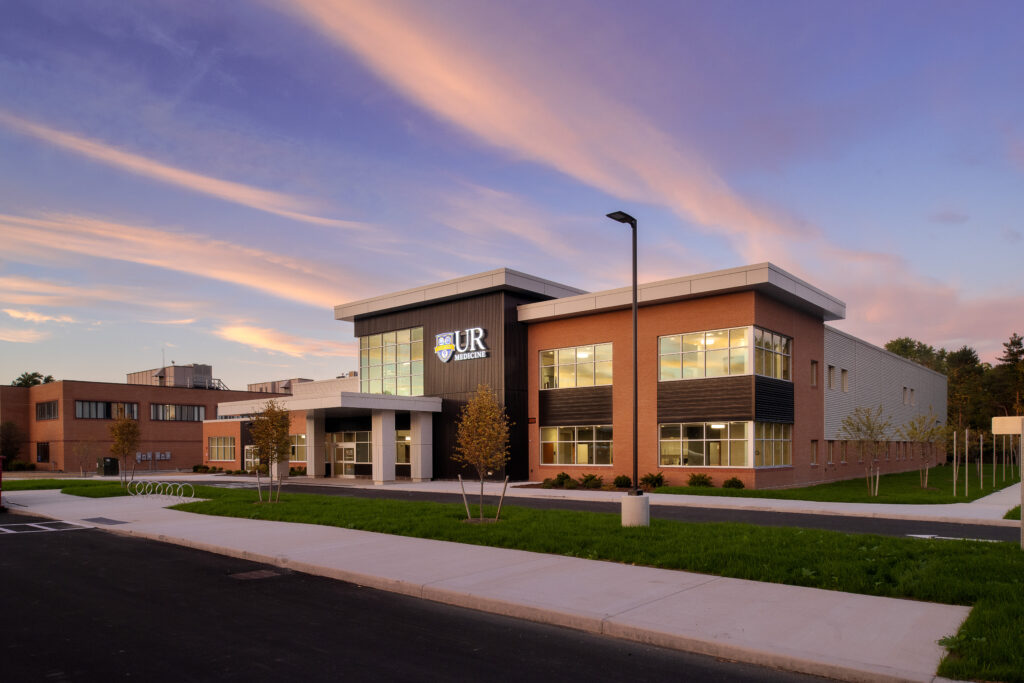
“Existing client relationships are still the key,” Liebert said. “We want to go in, build a relationship and stay with them.”
Health care provides a fairly significant percentage of work for the firm, especially as health systems continue to expand in Florida. CPL is working with seven different health systems in the Sunshine State “that’s just in 18 months,” Liebert said.
Because health care facilities are easily adaptable regardless of geography, it’s a logical growth sector, as is higher education.
And then, of course, there is the continuing integration of artificial intelligence. CPL has embraced AI, which is already bringing about industry changes, especially when it comes to traditional drafting and program creation, he said.
The full impact of AI isn’t known yet, Liebert said, but the industry will adapt, just as it did when AutoCAD replaced hand drawings, and then when Building Information Modeling trumped AutoCAD.
“You train AI to your standards and it allows you do more with less, so others can be doing other things and you’re not as restricted,” he said.
[email protected]/(585) 653-4020
n