Sign In
Upcoming Event
 Free Newsletter

Augmentiqs, a Luminate startup, adds a new layer to microscopy
Augmentiqs, a Luminate startup, adds a new layer to microscopy


In the field of pathology, there’s no tool more critical than the humble microscope. For nearly 400 years, microscopes have been central to biological study, and though they’ve become infinitely more powerful—the Lawrence Berkeley National Laboratory TEAM 0.5, for example, can magnify images as small as half the width of a hydrogen atom—their functionality has remained, in most settings, relatively the same as a non-collaborative device.
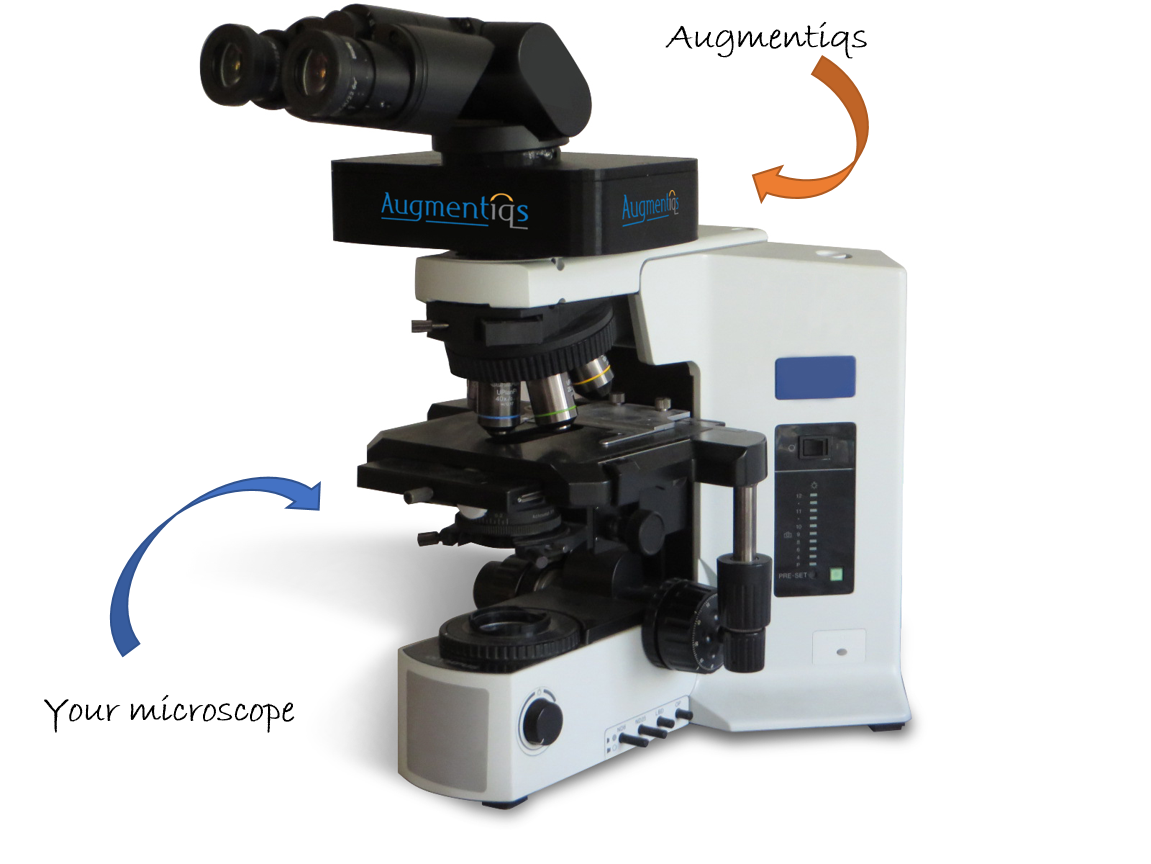
Israeli company Augmentiqs, a competitor in the second cohort of the Luminate NY accelerator, is seeking to change that. Augmentiqs is the creator of a device, easily retrofitted into most microscopes, that allows a pathologist to instantly capture and share information with fellow pathologists around the world.
According to CEO Gabe Siegel, Augmentiqs’ augmented reality platform gives pathologists instant access to a digital toolbox while looking through the glass of a microscope. It can quickly give data on cell count or other pieces of data right then and there, while at the same time allowing other pathologists to connect and give their own input in real-time. That, Siegel said, can drastically improve workflow and cut down on the time it takes to analyze a slide.
In surgical applications, where speed is critical, getting those results fast can be a real advantage. As an example, Siegel cited cryosection, or frozen section procedure, a type of biopsy usually done during cancer surgeries.
“Let’s say there’s a frozen section case where you’re in the OR. You have the pathologist off-site, it’s a remote OR, or there’s a pathologist that specializes in a specific type of tumor and he’s just not on call,” Siegel said. “The ability is to share an image of this tissue directly from the OR to the pathologist and they can direct the surgeon how to proceed with the surgery.”
That’s a real-world application that could save lives in some cases, but in day-to-day operations, Augmentiqs serves to bring the traditionally analog microscope into the world of digital medicine. Pathologists can now instantly save an image, with notes, for reference or analysis later, or get a second opinion quickly and accurately.
“These are all ideas which can really improve the workflow,” Siegel said.
Founded in 2016, Augmentiqs is now in the early sales phase of its business life cycle, making about 10 sales in 2018. Rochester is now home to the company’s sales and marketing department, through Luminate, and Siegel sees that as being a critical part of the company’s future. While right now Augmentiqs is focused on pathology labs, the applications are broad-reaching—from research to education.
“Once distribution is running and sales are being made (in the pathology market), we’ll start pivoting to other markets as well—anywhere there’s a microscope,” Siegel said. “Imagine even education, in a biology class in universities. Tests can be done inside the microscope, questions can be asked right inside the microscope. The applications are very wide-ranging.” Siegel has a lot of visions for what Augmentiqs technology can inevitably do. For instance, he foresees an artificial intelligence system that can be trained to provide constantly improving in-microscope information to the pathologist, student, researcher or scientist behind the microscope.
To understand how that works, think of the work a pathologist does as cutting through mountains of data, or noise, to find useful information. The right algorithm can train AI to find that data quickly and efficiently, cutting down on workflow, by using the work pathologists are already doing and adding new data to a collaborative network.
“What we’re able to do is piggyback off the work of pathologists, essentially for free,” Siegel said. “We’re essentially able to train the algorithm once there is an algorithm that is FDA approved and able to be deployed… All this work being done in AI is terrific, but these algorithms only have value if there is a platform for them to be deployed.”
The idea is ultimately for Augmentiqs to be that platform, an easy, cost-effective solution that creates an integrated pathologist network that can train and constantly improve artificial intelligence for diagnostics and other applications. That concept may be a bit far off for the young company, but it’s a future Siegel hopes for. Luminate NY, meanwhile, is already playing a critical role in reaching that goal.
“Looking forward, as a company seeking to ramp up sales and marketing, we see a lot of value in having the sales and marketing being based out of Rochester and having the people with right backgrounds to run it,” Siegel said.
[email protected]/(585) 775-9692
———————————————————————————————
Spotlight on Luminate
Ten companies composed of some of the brightest minds in the field of optics, imaging and photonics are fine-tuning their technologies inside NextCorps’ Luminate NY accelerator. The winners of November’s second Lightning Awards, these companies each received $100,000 in funding, free residency in the accelerator and access to NextCorps’ web of resources and mentoring. On June 27, the most promising of these 10 will receive a total of $2 million in follow-on funding. Originally funded for two years, the Luminate NY accelerator has now been funded for three more years via $15 million in additional state funding.
Leading up to Demo Day, the Rochester Business Journal is featuring profiles of the companies holding the keys to the next chapter in Rochester’s history as the world’s imaging center.