Sign In
Upcoming Event
 Free Newsletter

Hypervision redefines how humans see through remote machines
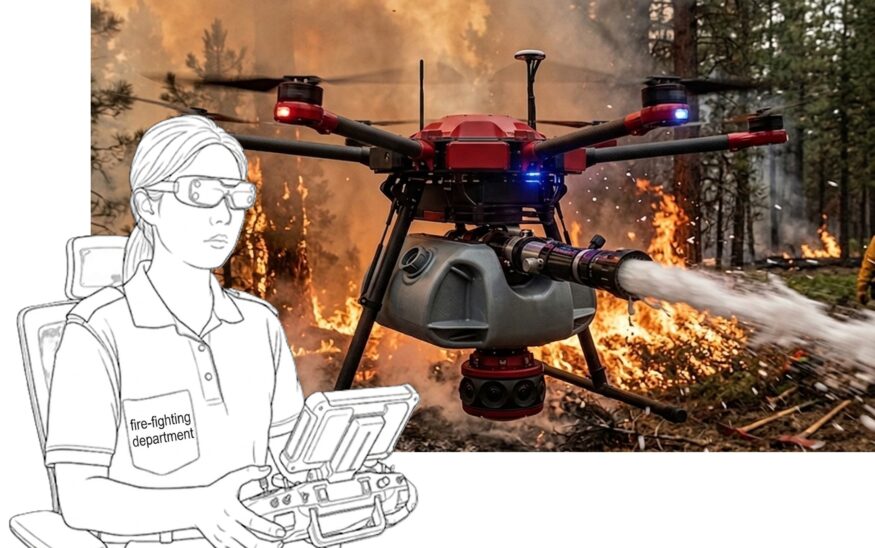
Example of Remote Fire-Fighting in Harsh Environment. (Photo provided by Hypervision)
Example of Remote Fire-Fighting in Harsh Environment. (Photo provided by Hypervision)
Hypervision redefines how humans see through remote machines


Unmanned vehicles, drones, and advanced robots handle increasingly dangerous missions. Yet, operators control these multi-million-dollar systems using flat monitors and narrow video goggles. This restrictive setup creates dangerous blind spots, disorientation, and heavy cognitive overload. During active emergencies or hazardous defense maneuvers, a split-second delay in human perception can cause a total mission failure.
 These risks aren’t acceptable to Hypervision Ltd. Instead of forcing operators to view complex scenes through a restrictive digital window, the startup has introduced a more practical way for humans to interact with remote machines. Its proprietary technology, Reality First Person View (rFPV), merges multiple camera feeds into a continuous, wide-field view. Because this view matches the natural scale, depth, and wide boundary of human sight—a concept known as human-scale telepresence—operators can easily spot peripheral obstacles and make quicker, more confident decisions from a safe distance.
Turning fragmented feeds into immersive scene awareness
Traditional remote-control setups force users to toggle between multiple monitors or look through basic, narrow First Person View (FPV) goggles. Hypervision eliminates this friction. Its rFPV platform maps 360-degree, stereo, and low-light camera feeds into a continuous view. This design ensures operators instinctively notice motion, obstacles, and peripheral threats that fall completely outside standard video windows. High-detail picture-in-picture windows layer over the view to preserve weapon sights, payload imagery, or artificial intelligence detections without losing full context.
The commercial urgency for this capability has intensified. Real-world tactical operations demonstrate that unmanned ground vehicles keep people out of harm’s way—but only if the operator perceives the scene with natural speed and confidence. Hypervision’s software achieves this without requiring a costly redesign of the robot itself. It layers directly onto existing 360-degree imaging hardware and operator terminals.
The business economics are equally compelling for fleet managers. While a modern robotic platform can cost hundreds of thousands or even millions of dollars, integrating an rFPV operator station requires a low relative investment of about $20,000. By maximizing human performance and decision confidence, this modest addition effectively triples the operational value of those expensive fleet assets—ensuring organizations get the absolute most out of their technology investments.
Equipping frontlines, first responders, and future avatars
Hypervision’s technology improves situational awareness across multiple high-stakes industries. The team is currently scaling its core perception engine to meet the specific needs of three target markets:
- Defense and tactical systems: Powering unmanned ground and aerial vehicles (UGVs/UAVs) to protect perimeter defense nodes and execute high-risk reconnaissance without exposing personnel to direct danger.
- Public safety and emergency response: Enabling firefighters, police departments, and hazardous material teams to navigate active disaster scenes safely while keeping first responders out of immediate harm’s way.
- Industrial supervision and future avatars: Supporting the emerging role of the “robotics operations supervisor,” where a single human can monitor and guide multiple autonomous systems. Over time, this path leads toward avatar-style remote presence for complex service, agriculture, healthcare, consumer, and industrial environments.
Advancing innovation through Rochester’s OPI assets
To speed the transition of its advanced optical designs into physical products, Hypervision applied to Luminate NY in Rochester, New York. As the world’s largest accelerator program for optics, photonics, and imaging (OPI) technologies, Luminate gives the Israel-based company a soft landing into the U.S. market alongside curated experts and investors.

“Luminate has helped us translate our technical strengths into compelling messages that we’re using to conduct further customer discovery,” says Dr. Arthur Rabner, founder and CEO of Hypervision. “We’re also getting exposed to the unique technical knowledge, specialized suppliers, and manufacturing experience that exists in the Finger Lakes that could help us move our advanced prototype optics toward a mass-manufacturable, U.S.-based product path.”
This production push will align perfectly with national efforts to modernize high-risk industries by pulling human workers out of hazardous environments.
“Addressing modern workforce shortages requires finding a better way to handle demanding, repetitive, and hazardous manual tasks,” notes Dr. Sujatha Ramanujan, managing director and chief investment officer of Luminate. “Hypervision’s technology will unlock opportunities to move more of these manual processes to intelligent systems. By allowing a human to operate seamlessly through a machine, the industry can achieve entirely new levels of operational access, precision, and efficiency that were previously out of reach.”
From concept to mass production
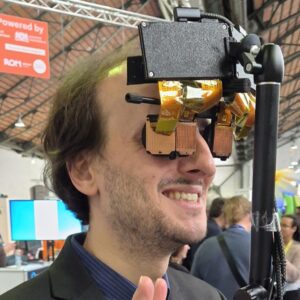
Hypervision established the initial utility of its technology through proof-of-concept collaborations with industry heavyweights Google and Anduril. These projects focused on advanced optics for Mixed Reality systems and future Soldier-Borne Mission Command (SBMC) helmets. Through these frameworks, the company released a proof-of-concept and demonstrated how ultra-wide visual engines can integrate natural human perception directly into unmanned platforms.
Using what they learned from these initial projects, Hypervision is now directing its attention away from prototyping toward hardware production. However, transitioning into physical manufacturing requires significant capital. The company hopes that when Luminate concludes with its Finals competition on September 30, they’re named Company of the Year—a distinction that comes with $1M in follow-on funding. The event, supported by Empire State Development’s Finger Lakes Forward Upstate Revitalization Initiative, will award more than $2M in investments to select companies in cohort 9.
“Securing this investment will allow us to establish a permanent U.S. operating entity and immediately fund our first optics pilot manufacturing batch with Rochester-area full-cycle production, including optical injection molding and coating partners,” says Rabner. “This capital will establish the inventory readiness we need to supply our rFPV visual engines on demand for upcoming customer trials, while formalizing our research partnerships with the Rochester Institute of Technology and the University of Rochester.”
For more information about the Luminate accelerator and Finals 2026, visit luminate.org.
e