Sign In
Upcoming Event
 Free Newsletter

Liquid Sports Lab aims to be Rochester’s version of ‘Moneyball’
Using biotech, advanced analytics to help athletes make better-informed decisions

This shows an example of how Liquid Sports Lab analyzes pitching mechanics. (Image provided by Liquid Sports Lab)
This shows an example of how Liquid Sports Lab analyzes pitching mechanics. (Image provided by Liquid Sports Lab)
Liquid Sports Lab aims to be Rochester’s version of ‘Moneyball’
Using biotech, advanced analytics to help athletes make better-informed decisions


 Listen to this article
When Roy Krishnan was playing baseball as a high school junior, he had both the grades and the arm to attract interest from more than a dozen colleges at the Ivy League and NCAA Division III levels.
Every other day, it seemed he was speaking to a coach who was on the recruiting trail.
Then he tore the ulnar collateral ligament in his pitching elbow, underwent what is commonly referred to as Tommy John surgery and couldn’t play his senior season.
And just like that, the only people calling him were his family and friends in the Westchester County town of Scarsdale.
“I know what it’s like to have 15 colleges talking to you,” Krishnan said, “and then the next week to have none of those people return your phone calls.”
Which is why he’s now intent on trying to prevent others from experiencing a similar plight, using biotechnology and quantitative measures to help lessen the injury risk for Rochester-area high school and college baseball players while enhancing their abilities on the diamond.
Armed with an engineering degree from the University of Rochester, player-development analytics experience with the National Basketball Association’s Dallas Mavericks and Toronto Raptors, and his love of baseball, Krishnan operates Liquid Sports Lab in the city of Rochester.
Pitching and hitting mechanics are analyzed through image captures, then code written by Krishnan and his team turns that data into easy-to-read visuals that help athletes understand the repetitive motions and physics behind success as well as injury.
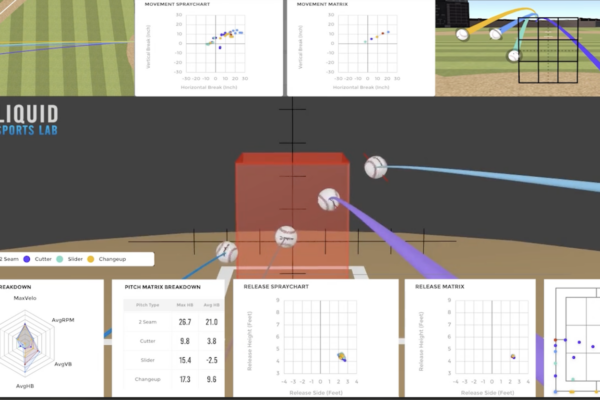
Sometimes it’s a breakdown of pitching mechanics, detailing elbow flexion, shoulder abduction and hip/shoulder separation. Other times it might be a spray chart breaking down the flight path of pitches, from both the pitcher’s point of view and the hitter’s POV.
“When we quantitatively gauge some of those variables, you have to be able to get through to the kids quickly,” he said.
From that data, drills are created so pitching motions become less stressful on the elbow, shoulder and hips for pitchers, and swings become more consistent for hitters. And as a result, performance is often enhanced through the 4 C’s of analytics at Liquid Sports Lab: collect, compare, correct, compete.
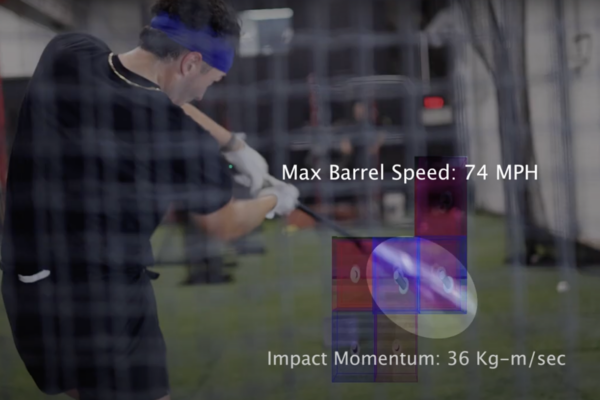
“It’s all about individualization,” said Krishnan, 25. “How do I make you the best you? We’re basically re-wiring the nervous system and we can literally tell you how much better you can get.”
In essence, Krishnan is playing a little Moneyball. In “Moneyball,” first the book by Michael Lewis and then the movie starring Brad Pitt, Oakland A’s general manager Billy Beane relied on advanced analytics to make informed decisions on roster construction.
“This is Moneyball 2.0,” said Krishnan, who was recently named to the Front Office Sports Rising 25 Class of 2024. “We find deficient players and turn them into efficient players. Not everyone is going to throw 100 mph, but we can still make you the best version of you.”
They rely on biotechnology and math to do so, and so far, their track record is pretty good. Last month University of Rochester pitcher Nolan Sparks was selected on the 13th round of the Major League Baseball draft by the St. Louis Cardinals. He worked with Krishnan on mechanics.
Matthew Sanfilippo of Webster threw a fairly decent high school fastball, around 76 mph, as a sophomore at Webster Schroeder. By his junior year he was throwing in the mid-80s and when in junior college was at 92 mph, earning a partial scholarship at Eastern Michigan University.
“Baseball is rooted in history, but with that history, sometimes it’s really tough to change how people think,” said Krishnan, who pitched for the University of Rochester baseball team during his time on campus. “Math gives you a more honest representation of yourself. We find efficiencies and deficiencies, the same as you would if you audited a business.”
Sanfilippo’s father, Mat, is a baseball coach at Schroeder and with the Webster travel program. He’s also Krishnan’s partner in Liquid Sports Lab.
At 45, he played the game at a time when comparing batting averages and a pitcher’s walk and hit ratios compared to innings pitched were considered advanced analytics. But he embraced the new baseball years ago.
“I used to tell my son, ‘There’s a mathematical equation that will get you drafted, but you have to buy into it,’ and he did,” Sanfilippo said.
Krishnan actually founded Liquid Sports Lab in his dorm room at the U of R in 2020 but chose to work in professional sports following graduation in 2021. He was hired to do player analytics with the NBA’s Dallas Mavericks for the 2021-22 season, and the following season filled a similar role with the Toronto Raptors.
He then decided to take Liquid Sports Lab to the next level, moving back to Rochester to launch the business full-time. He and Sanfilippo operate in a converted warehouse at 750 St. Paul St.
“I decided if I was ever going to do this, it’s got to be now,” Krishnan said. “A lot of people are doing this, but no one is doing it in Rochester, Syracuse or Buffalo, at least not the way we are doing it. I want to be the person that brings Moneyball to Upstate New York.”
[email protected]/(585) 653-4020
n