Sign In
Upcoming Event
 Free Newsletter

RIT’s SHED combines tech, the arts and design fields in new multi-use space

Work on the $120 million building began at the height of the COVID-19 pandemic in 2020. (Photo by Andrea Deckert)
Work on the $120 million building began at the height of the COVID-19 pandemic in 2020. (Photo by Andrea Deckert)
RIT’s SHED combines tech, the arts and design fields in new multi-use space


 Listen to this article
If you want to understand the essence of Rochester Institute of Technology, your best bet may be to visit the newly unveiled Student Hall for Exploration and Development.

“The SHED is a place where prospective students and their parents will stop by and, in just five or 10 minutes, say, ‘Oh, this is RIT,’ and see that we are different from almost every other institution,” said David Munson, RIT’s president.
The SHED, which is RIT’s largest capital project since the Henrietta campus was established in 1968, opened this fall. Work on the $120 million construction project started in 2020.
When Munson proposed the new multi-use building, he envisioned the SHED as a place that celebrates RIT’s intersection of technology, the arts and design.
No other university has a building that incorporates all the SHED elements, he noted.
The 209,000-square-foot project includes 126,000-square-feet of new space, as well as 83,000-square-feet of renovations in Wallace Library and Monroe Hall, located on either side of the SHED.
The entrance to the building opens to a three-story, 98-foot-tall atrium, which is becoming a popular place for students to study and interact.
RIT created 27 new classroom spaces within the SHED and Wallace Library. That includes 22 standard-size classrooms and five extra-large classrooms on the top two floors for active learning.
All the new classrooms feature innovative video technology and flexible furniture for group work, lectures, symposiums and special events.
There are also seven engineer and technology makerspaces, which include studios for competitive engineering teams, digital making, fabric and electronics and Virtual Reality and Artificial Intelligence. A public store-front display room features creations and student designs developed in the various makerspaces.
Additionally, seven competitive student performance teams have dedicated SHED space, including 2 e-vehicle teams and two robotic teams.

A portion of the building is dedicated to the performing arts.
The SHED houses individual rehearsal spaces, a large movement/dance instruction studio and a Sonic Studio for music creation and rehearsal. A black-box/glass-box theater that seats 180 is reconfigurable to control the light entering the facility.
While roughly 70 percent of RIT students are studying the science, technology, engineering and mathematics (STEM) fields, the school has always been strong when it comes to the studio arts, according to Munson.
The SHED, he said, allows them to “dream, design and build.”
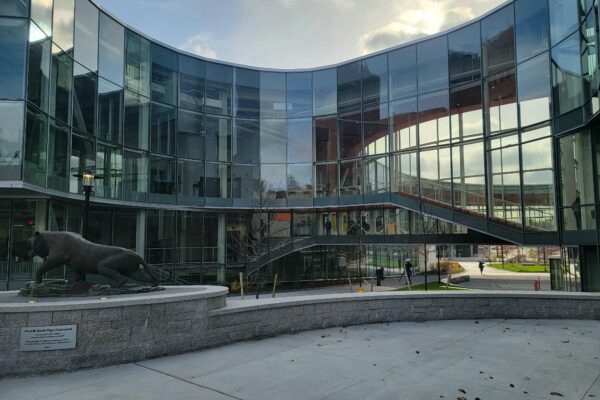
In addition to the offerings in the building, the architectural style of the SHED departs from the brick-centric construction of RIT’s early buildings on the campus. Instead of brick, glass is the dominant material in the SHED.
Boston-based William Rawn Associates Architects served as the architect on the project.
The design also includes natural spaces, a courtyard and landscaped passages weaving through the building and under a glass bridge.
The structure will not be the only unique building on campus, Munson said, noting a new 750-seat music performance theater under construction features the work of renowned Los Angeles-based architect Michael Maltzan, whose projects cross a wide range of typologies, from cultural institutions to city infrastructure.

Tiffany Brodner executive director of the SHED, said the new building has been well received by students, noting many remain after classes to study and socialize.
Some 15,000 people visit the SHED daily.
Financing through the Dormitory Authority of the State of New York offset the construction costs of the project, which exceeded $100 million.
A number of donors have also supported the SHED.
That includes RIT Trustee, 2009 alum and Datto founder Austin McChord, whose 2017 record gift of $50 million to RIT included $17.5 million to build the collaborative learning complex.
A gallery dedicated to RIT’s partnership with the Genesee Country Village & Museum on the first floor of the SHED showcases university-wide research and scholarship from the partnership.
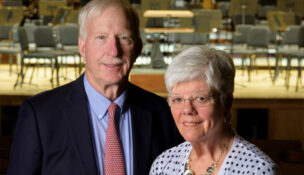
RIT alum Philip Wehrheim and his wife, Anne, endowed the RIT-GCV&M partnership in 2019 with a $1.3 million gift, a portion of which is supporting the exhibition space.
In addition, RIT alum and trustee Frank Sklarsky and his wife, Ruth, donated $2.5 million to establish the Sklarsky Glass Box Theater.
[email protected] / (585) 653-4021
t