Sign In
Upcoming Event
 Free Newsletter

As pandemic progresses, construction industry faces tightened supply chains, labor shortage
As pandemic progresses, construction industry faces tightened supply chains, labor shortage


While the United States is in a recession due to the COVID-19 public health crisis, local construction companies report that they are still keeping busy with projects.

Tony Soprano, vice president of preconstruction services at DiMarco Constructors, says “steady is the best way to describe it” in terms of how the market for construction projects is currently.
DiMarco, which operates in multiple markets, is still seeing steady work in building multifamily housing and market rate housing, as well as some small retail, Soprano says. However, big retail projects have dried up.
DiMarco’s diversification across different states and different types of projects like multifamily, affordable housing, medical, institutional and retail means it can weather downturns, Soprano says.
Karl Schuler, president of Taylor, The Builders, says that until the presidential election is over, construction projects are being held back because no one wants to loan money. People don’t want to even go through the preliminary stages of planning and financing projects because they’re not sure how they will work out, he says.
Historically, the low interest rates would be sparking construction, Schuler says.
“Banks right now have a lot of money,” Schuler says. “Corporations are sitting on a lot of money. They’re not going to put that into play until they know what the tax policy is going to be. They’re not going to put that into play until they know what direction the economy is going.”
Whichever presidential candidate wins the election, Schuler says he expects to see a recovery in the construction market because capital will be freed up.
However, Schuler predicts that some types of projects like hotels and office projects will not rebound because of the drop-off in travel due to the pandemic, as well as the uptick in working from home.
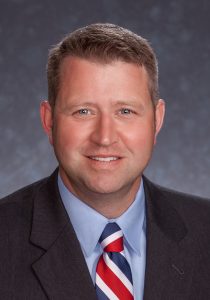
Lee Sommerman, region vice president of operations for LeChase Construction’s Rochester and Syracuse markets, notes that “construction is a lagging indicator” of the health of the economy.
“We aren’t seeing a tremendous issue in 2020,” Sommerman says. “A lot of work we had is ongoing. What we’re very much focused on is ‘21, ‘22 or ’23,” and if the United States goes through a longer downturn.
Two of LeChase’s biggest markets are health care and higher education, Sommerman says.
Health care projects like the Rochester Regional Health’s Sands-Constellation Center for Critical Care were able to stay on track to open this fall, Sommerman notes.
In terms of higher education, many local institutions are focusing on the safety of their students rather than “building new buildings right now,” Sommerman says. But there have been COVID-19 specific needs like a discussion of building fiberglass booths for COVID-19 triage rather than trying to use tents in inclement weather.
LeChase also has seen a demand from pharmaceutical businesses it serves to build clean rooms and other hi-tech spaces, Sommerman says.
“That’s been a direct response to COVID to help deal with the pandemic,” Sommerman says. “Other areas are reacting to a pent-up demand for new products because they all took time off. All of a sudden they are bringing things to the market.”
One challenge that has emerged from the pandemic are tightened supply chains for construction materials.
“Production has really stalled or slowed down,” Soprano says.
Appliances can’t be obtained slowly, Soprano says, and DiMarco is currently ordering appliances 18 months ahead of time. They are putting them in storage just to have them on-hand to help keep the projects moving forward, Soprano says.
Schuler notes that for materials like floor tiles, manufacturers make certain colors and styles on cycles through the year, alternating with other colors and styles. When manufacturing was shut down because of COVID, certain colors and styles were not made on their normal cycle and are now in short supply.

The price for lumber also has spiked, Schuler and Sommerman say.
“The driver for the lumber pricing was not the construction industry,” Schuler says. “It was the homeowner.”
When people were staying at home under public health orders, they were fixing their houses, Schuler says.
Sommerman also says that “COVID really disrupted the supply chain. It kept people out of the woods and kept people from running lumber across the country.”
As a result, LeChase had to change projects that were originally supposed to be wood-framed.
Another challenge that has emerged from the pandemic is a tightened market for the construction workforce.
“Because the work stalled and now it’s coming online all at once, it’s definitely a strain on subcontractors,” Soprano says.
Sommerman notes that there already were not enough people in the construction trades.
“It was further constrained by COVID,” Sommerman says. “We’re not seeing any ability for people to travel out of state.”
Sommerman notes that some people are also not choosing to go to work because of personal health reasons.
According to Sommerman, subcontractors are investing in prefabrication of things like a typical restroom or warehouse assembly line. This is due to the tightness of the labor pool as well as the requirements for social distance on site, he says.
Soprano says DiMarco is looking to hire different contractors to do parts of projects rather than hire one contractor to do the entire scope of a project because contractors do not have the means to staff an entire project right now. For example, they may have to engage contractors to complete things like drywall floor by floor of a multistory building.
Schuler says that some lower-skilled workers who filled jobs as laborers and assistants have not returned to work, perhaps because of expanded unemployment benefits.
Workers from the skilled trades and craftsmen like carpenters, electricians and plumbers now have to do things like both carrying their own pipe and installing the pipe, Schuler says. That has slowed down productivity.
“We’re definitely in a tough supply for labor,” Schuler says.
Amaris Elliott-Engel is a Rochester-area freelance writer.
d