Sign In
Upcoming Event
 Free Newsletter

In East Rochester, it’s easy being green with small, carbon-friendly homes

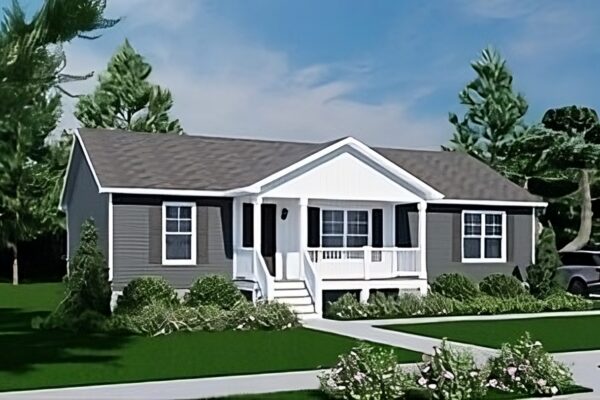
GreenDoor Builders Inc. built and erected a modular home on Garfield Avenue in East Rochester last fall. (Photo provided by GreenDoor Builders)
GreenDoor Builders Inc. built and erected a modular home on Garfield Avenue in East Rochester last fall. (Photo provided by GreenDoor Builders)
In East Rochester, it’s easy being green with small, carbon-friendly homes


 Listen to this article
Drive through East Rochester on any given day and you’re not going to find construction underway on many big, new housing tracts.
Or any, for that matter.
“We’re fairly built out,” said John Alfieri, mayor of the village.
Indeed, the choices are limited when it comes to expanding housing options. Rather than large plots of land that a developer can transform into a housing community, there are odd-sized empty parcels sprinkled about the village.
“Forty-by-120 is the lot size in East Rochester,” Alfieri said. “We’d bring developers in and ask, ‘What could you do?’”
The answer was pretty much always the same: not much.
But when Anthony Ottaviani looked at a 40-foot-x-90-foot lot in the middle of Garfield Avenue, abutted by homes directly to the east and west, he saw opportunity.
While traditional homebuilders would find construction of a new house on the lot cost prohibitive, Ottaviani set out to prove the property could be quite useful.
Ottaviani is the founder of GreenDoor Builders Inc. The company markets carbon-friendly modular homes that provide an affordable option to homebuyers.
GreenDoor’s first foray into the housing market sits at 206 Garfield Ave., squarely in the heart of the village.

Where just an old shed once stood, there now is a 1,400-square-foot ranch home with three bedrooms, two bathrooms, a full basement and a garage. The price tag is around $295,000 (excluding the lot). A traditional new build of the same size would be around $375,000, Ottaviani said.
“It shows we can put a great house in a small area and still have a spacious living environment,” Ottaviani said. “No traditional builder would have touched it. There would have been no way to make money.”
The house blends in well, too.
“It looks like it’s been here forever,” Alfieri said.
Ottaviani believes GreenDoor offers solutions to housing affordability and availability. Few first-time homebuyers can afford new builds, the price of existing stock has soared and contractors aren’t looking to build on cramped, oddly-shaped lots.
“Our mission is to democratize sustainable living, particularly in urban areas where space is at a premium and environmental impact tends to be more pronounced,” Ottaviani said. “These homes demonstrate that regardless of location, you can substantially reduce your carbon footprint while enjoying all the comfort and style of a traditionally built home.”
East Rochester declared itself a pro housing community earlier this year. It’s a New York State initiative meant to encourage municipalities to create more affordable housing options. Alfieri trumpets GreenDoor’s approach.
“A lot of new housing isn’t affordable, especially to the first-time homebuyer,” he said. “A lot of villages would maybe not be in favor but we’re being open-minded to modular builds.
“That home is beautiful; it’s more modern than a lot of homes built in the village and has a lot of amenities the older homes in East Rochester don’t have.”
Some of those amenities involve the green element. GreenDoor’s homes are all-electric; there is no natural gas connection. A cold-climate heat pump is used for heating and cooling. There are two inches of closed-cell, spray foam insulation in the walls, R-value triple-pane windows and R-49 ceiling insulation.
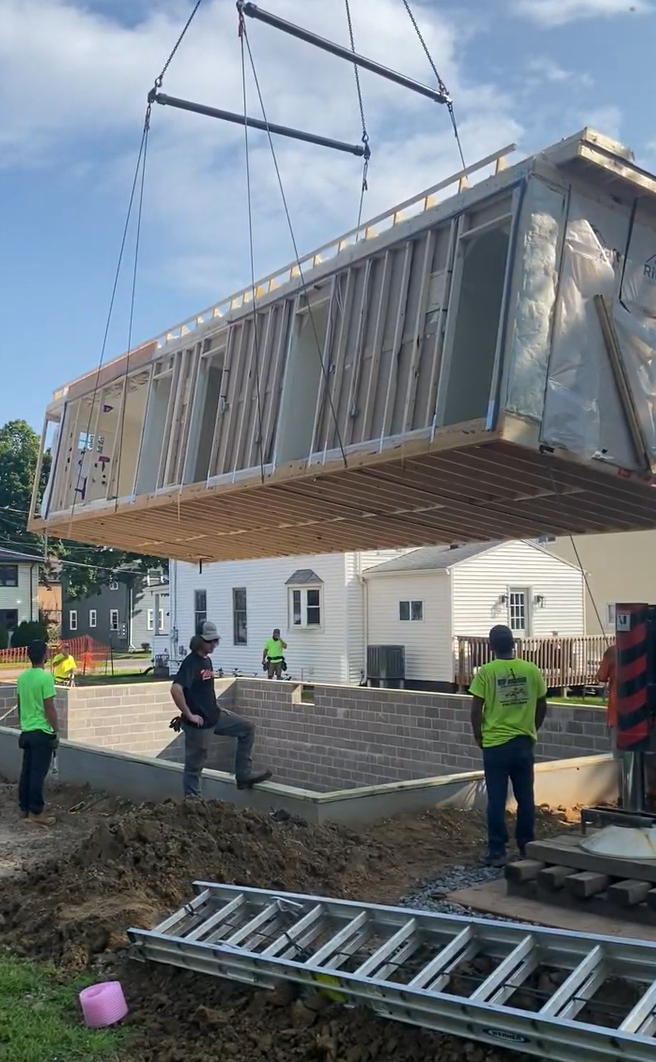
The homes also can be built quickly. They are assembled at a factory in Pennsylvania, shipped to the site in pieces, then moved into place by crane and installed on the foundation.
“The joke is, you went to work and there was a basement and you came home from work and there was a house,” Ottaviani said. “We can potentially have a house in approximately three weeks.”
The permitting and approval process also can be condensed, especially in communities accepting of modular homes.
Proof of the village’s willingness to create new housing: GreenDoor went before the East Rochester Zoning Board in April. The house was ready to market last week.
“We’re able to turn plans over to the town and can build in five to 10 months,” Ottaviani said.
Said Alfieri: “I applaud our zoning board for their open-mindedness.”
GreenDoor offers four models, ranging from 1,100 square feet to 1,425. Once the style and floor plan is chosen, homebuyers choose their fixtures and finishes. In the near future, Ottaviani said the company will incorporate augmented reality into the buying process.
“The homeowner will open the front door and through AR be able to pick and choose the finishes,” Ottaviani said.
He said you’re not going to know the finished product was built through modular construction.
“The stigma of manufactured modular has been around but I’m telling you these houses are built better than a stick house,” Ottaviani said. “And the way we build them, there’s less waste. They’re built to scale.”
The products are billed as Carbon Friendly Affordable Homes. Sustainable modular construction methods in a controlled indoor environment lead to lower carbon emissions.
Add in the relative affordability and the ability to utilize confined lots and there may be significant promise in the concept.
“We know this is a long-term, viable solution,” Ottaviani said.
[email protected]/(585) 653-4020
l